
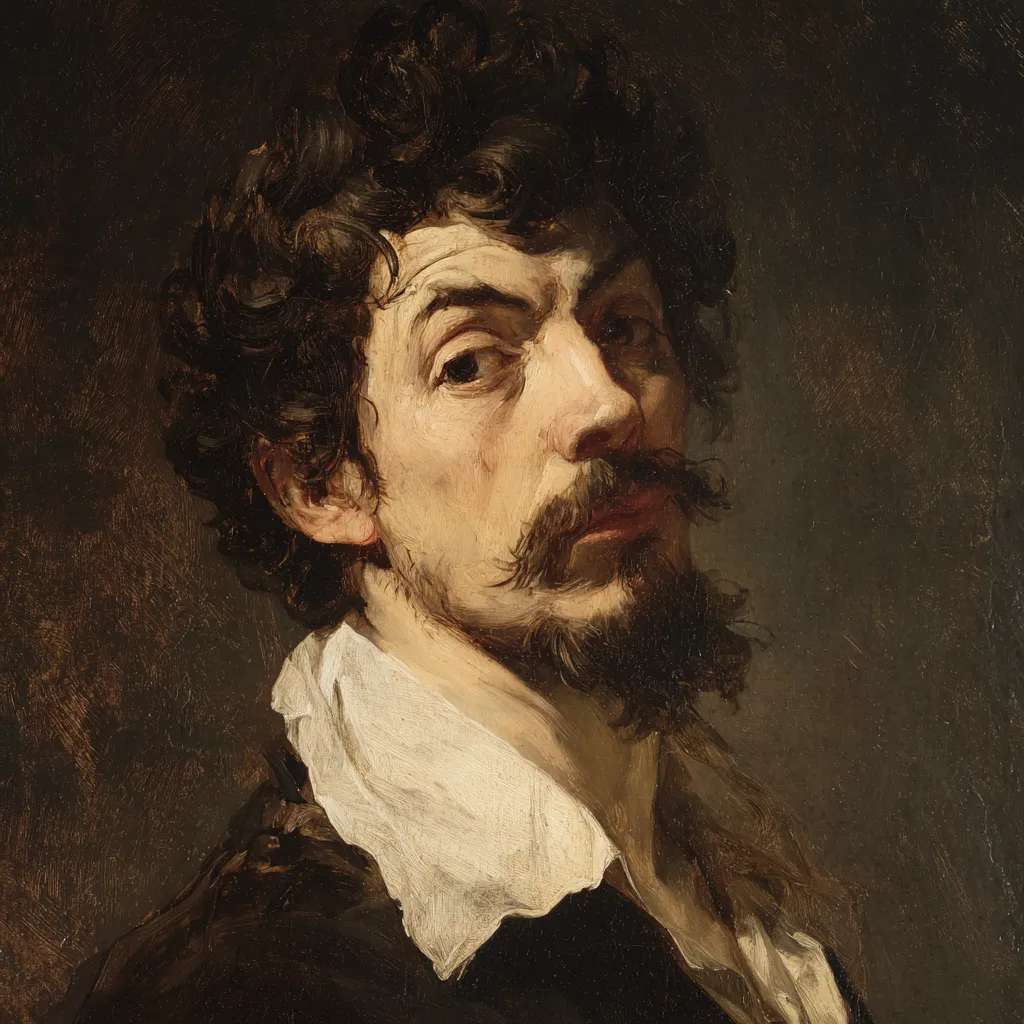
Who was Caravaggio?
Michelangelo Merisi da Caravaggio (29 September 1571 – 18 July 1610) was an Italian painter active in Rome who transformed Western art through his radical naturalism and dramatic use of chiaroscuro, a technique he intensified into what became known as tenebrism. His vivid depictions of religious subjects combined with a violent, turbulent personal life — including a killing that forced him into permanent exile — made him one of the most formative and controversial figures of the Baroque era.
Italian Baroque painter whose dramatic use of light and shadow revolutionized art in the early 17th century. His realistic depictions of religious scenes and turbulent personal life made him both a artistic genius and a controversial figure of his time.
Don't stop at the facts — continue Caravaggio's story in free narrated chapters on Chunks.
 Download on iOS
 Download on Android
Quick facts
- Born
- 29 September 1571
- Birthplace
- Milan
- Died
- 18 July 1610
- Place of death
- Porto Ercole
- Nationality
- Duchy of Milan
- Occupation
- Painter
Caravaggio: key facts
- Caravaggio was born Michelangelo Merisi on 29 September 1571 in Milan, where his father worked as a household administrator for the Marquess of Caravaggio.
- In 1584, Caravaggio began a four-year apprenticeship under Milanese painter Simone Peterzano, who was described in the apprenticeship contract as a pupil of Titian.
- Caravaggio developed the technique of tenebrism, transfixing subjects in bright shafts of light against deeply darkened shadows, making it the dominant stylistic element of his work.
- In 1606, Caravaggio killed Ranuccio Tomassoni in a brawl and fled Rome under a death sentence, spending his remaining years moving between Naples, Malta, and Sicily.
- While in Malta in 1608, Caravaggio painted the Beheading of Saint John the Baptist — his largest work, measuring 370 by 520 centimetres, and the only painting he signed.
- Artists most deeply influenced by Caravaggio's style were called the Caravaggisti, and his direct or indirect influence extended to Rubens, Velázquez, and Rembrandt.
- Caravaggio died on 18 July 1610 at Porto Ercole, near Grosseto in Tuscany; research published in 2018 concluded he likely died from sepsis caused by a wound sustained in a Naples brawl.
From Milan to Rome: Training and Arrival in the City
Michelangelo Merisi da Caravaggio was born in Milan on 29 September 1571. His father, Fermo, worked as a household administrator and architect-decorator for the marquess of Caravaggio, a town east of Milan. In 1576 the family relocated to Caravaggio to escape a plague devastating Milan, and both Caravaggio's father and grandfather died there on the same day in 1577. His mother raised five children in poverty before dying in 1584, the same year he began a four-year apprenticeship under the Milanese painter Simone Peterzano.
Growing up in Lombardy exposed him to a regional artistic tradition that prized simplicity and naturalistic detail, quite different from the stylised grandeur of Roman Mannerism. He would also have encountered Leonardo da Vinci's Last Supper among the art treasures of Milan. Around 1592 he left for Rome following quarrels that included the wounding of a police officer. He arrived, by one account, penniless and without fixed lodgings, eventually finding work painting flowers and fruit in the busy workshop of Giuseppe Cesari, Pope Clement VIII's favoured artist.
Tenebrism, Realism, and the Rise to Fame in Rome
Caravaggio's breakthrough lay in combining acute observation of physical reality with a technique that came to be called tenebrism — a dramatic shift from brilliant light to deep shadow with little intermediate gradation. He worked directly on the canvas from live models, largely bypassing the preparatory drawings conventional in central Italy at the time. His earliest surviving works already display the intense particularity that would define his career: the produce in one early painting has been examined closely enough for individual cultivars and plant diseases to be identified.
His first compositions with multiple figures, The Fortune Teller and The Cardsharps, attracted the attention of Cardinal Francesco Maria del Monte, one of Rome's leading connoisseurs. Del Monte purchased both works and became a crucial patron. For del Monte's circle Caravaggio produced intimate cabinet pieces featuring adolescent models and began his first religious paintings, including the Penitent Magdalene, which depicted Mary Magdalene with the understated realism of a Lombard genre scene rather than the theatrical piety typical of Rome at the time.
In 1599, through del Monte's influence, Caravaggio was commissioned to paint two large canvases for the Contarelli Chapel in the church of San Luigi dei Francesi. The Martyrdom of Saint Matthew and The Calling of Saint Matthew, delivered in 1600, caused an immediate sensation. Younger painters gathered around him, and contemporary observers called him the unique imitator of nature. Several subsequent religious commissions were rejected because his unflinching realism — peasant-like saints, a Virgin modelled on a well-known prostitute — clashed with the expectations of the bodies who had ordered them, yet rejected works were promptly snapped up by aristocratic collectors.
Violence, Murder, and Exile from Rome
Caravaggio's police record was extensive even before his most serious crime. He was arrested for brawling and carrying illegal weapons, sued for throwing a plate of artichokes at a tavern waiter, hospitalised after allegedly falling on his own sword, and forced to flee briefly to Genoa in 1605 after seriously injuring a notary in a dispute over a woman named Lena, described in court documents as his model and lover.
On 29 May 1606 he killed Ranuccio Tomassoni, a young man from a wealthy family with whom he had argued repeatedly. The exact circumstances remain unclear — contemporary accounts mention a gambling debt, a pallacorda game resembling tennis, and a dispute over a prostitute named Fillide Melandroni who had modelled for several of his paintings. Regardless of cause, Tomassoni's powerful family demanded justice, and Caravaggio's patrons could not shield him this time. He was sentenced to death by beheading, and an open bounty was placed on him, legally permitting anyone who recognised him to carry out the sentence. He fled Rome immediately.
From this point his paintings began to feature decapitated heads with striking frequency, often bearing his own likeness. He moved first to estates belonging to the Colonna family south of Rome, then on to Naples, Malta, and Sicily — tracing an arc of exile that would last the remaining four years of his life.
Malta, Sicily, and the Final Years
In Naples, outside Roman jurisdiction and under the protection of the Colonna family, Caravaggio quickly re-established himself as the most prominent painter in the city. He secured major church commissions including The Seven Works of Mercy, still housed in the church of Pio Monte della Misericordia for which it was painted. He then travelled to Malta in 1607, apparently hoping that the patronage of Alof de Wignacourt, Grand Master of the Knights of Saint John, might help him obtain a papal pardon. Wignacourt was so pleased with Caravaggio's work that he inducted him into the Order as a knight.
The Beheading of Saint John the Baptist, painted in Malta, was his largest ever work and the only painting he signed. Measuring 370 by 520 centimetres, it still hangs in St John's Co-Cathedral in Valletta. Yet by late August 1608 he had been imprisoned by the Knights following another violent incident involving an aristocratic knight, and he managed to escape. By December he had been formally expelled from the Order. He made his way to Sicily, where his old friend Mario Minniti helped him obtain commissions in Syracuse and Messina. Contemporary reports from this period describe increasingly erratic behaviour — sleeping fully armed and clothed, tearing up a painting at the mildest criticism.
Caravaggio returned to Naples in late 1609, where he survived what appeared to be an assassination attempt that left his face seriously disfigured. He painted a Salome with the Head of John the Baptist and sent it to Wignacourt as a plea for forgiveness. In the summer of 1610 he boarded a boat northward, apparently in the belief that a papal pardon was close. He died on 18 July 1610 in Porto Ercole, near Grosseto in Tuscany. Contemporary reports attributed his death to fever. Later research has suggested causes ranging from lead poisoning to sepsis from a wound sustained in the Naples brawl, while some accounts have always maintained he was killed by enemies.
Influence: The Caravaggisti and the Reshaping of Western Painting
Caravaggio's impact on younger painters was immediate and far-reaching. The installation of the Saint Matthew canvases in the Contarelli Chapel drew a generation of ambitious artists toward his approach. Early followers in Rome included Orazio Gentileschi and his daughter Artemisia Gentileschi, herself considered one of the most gifted painters of the movement. Catholic artists from Utrecht — among them Hendrick ter Brugghen, Gerrit van Honthorst, and Dirck van Baburen — travelled to Rome, absorbed his style, and carried it back to the Netherlands, where its effects can be traced in later painters including Vermeer and Rembrandt, neither of whom ever visited Italy.
Peter Paul Rubens, who was in Rome in 1601, recommended to his patron the Duke of Mantua that he purchase Caravaggio's Death of the Virgin, which was no sooner removed from the Carmelite church that had rejected it than Rubens urged its acquisition. The Spanish connection — Naples being a possession of Spain — helped shape a distinct Spanish branch of Caravaggio's influence, visible in painters such as Jusepe de Ribera and, at a distance, Velázquez. As fashions shifted toward the Baroque style that Caravaggio himself had done so much to create, his reputation faded. He had never established a workshop or set down his ideas in writing, leaving no school to carry his methods forward. It was not until the 1920s, when art critic Roberto Longhi returned his name to prominence, that the full scale of his importance to Western painting began to be properly recognised.
Caravaggio: timeline
- 1571Born in Milan, where his father worked as a household administrator and architect-decorator to the marquess of Caravaggio.
- 1584Began a four-year apprenticeship under Milanese painter Simone Peterzano the same year his mother died, marking the start of his formal artistic training.
- 1592Left Milan for Rome following quarrels and the wounding of a police officer, arriving impoverished and without a fixed address.
- 1599Secured a contract to decorate the Contarelli Chapel in San Luigi dei Francesi, his first major public commission in Rome.
- 1600Delivered The Martyrdom of Saint Matthew and The Calling of Saint Matthew to the Contarelli Chapel, causing an immediate sensation and establishing his fame.
- 1606Killed Ranuccio Tomassoni in a brawl, received a death sentence for murder, and fled Rome, never to return as a free man.
- 1607Arrived in Malta, where Grand Master Alof de Wignacourt was so impressed that he inducted Caravaggio as a Knight of the Order of Saint John.
- 1608Completed the Beheading of Saint John the Baptist in Malta, his largest ever painting and the only work he signed, before being expelled from the Order after a violent incident.
- 1609Returned to Naples after time in Sicily, where an ambush left his face seriously disfigured and sparked rumours in Rome that he had died.
- 1610Died of fever at Porto Ercole in Tuscany while travelling north from Naples toward Rome, reportedly hoping to receive a papal pardon.
Listen: stories featuring Caravaggio
Narrated chapters from the Chunks Microlearning app. Read a preview here, or listen to the full story in the app.
Continue Caravaggio's story
You've read the summary — hear the full story as narrated 5-minute chapters on Chunks, alongside 200+ figures and events from history, philosophy and science. Free to start on iOS and Android.