
Who was Augustus?
Hear Augustus's story
Chapter 1 of The Rise and Fall of the Roman Empire · the full story is in the app
Augustus (23 September 63 BC - 19 August AD 14) was the first Roman emperor, ruling from 27 BC until his death. Born Gaius Octavius, he rose to power as Julius Caesar's heir, defeated Mark Antony and Cleopatra at Actium in 31 BC, and transformed the Roman Republic into an empire, establishing the principate and ushering in two centuries of relative peace known as the Pax Romana.
First Roman emperor, who defeated Antony and Cleopatra and turned the Republic into an empire.
Don't stop at the facts — continue Augustus's story in free narrated chapters on Chunks.
See how Chunks works → Download on iOS
 Download on Android
Quick facts
- Born
- 63 BC
- Birthplace
- Rome
- Died
- 19 August 14
- Place of death
- Nola
- Nationality
- Ancient Rome
- Occupation
- Politician, military personnel, ruler
Augustus: key facts
- Augustus was born Gaius Octavius in Rome on 23 September 63 BC and died at Nola on 19 August AD 14.
- He was the great-nephew of Julius Caesar, who named him his primary heir in his will and whose name he assumed after the assassination in 44 BC.
- Alongside Mark Antony and Marcus Lepidus, he formed the Second Triumvirate in 43 BC, defeating Caesar's assassins at the Battle of Philippi in 42 BC.
- His fleet, commanded by Marcus Agrippa, defeated Mark Antony and Cleopatra at the Battle of Actium in 31 BC, leading to their suicides and Rome's annexation of Egypt in 30 BC.
- In 27 BC the Senate granted him the title Augustus, making him Rome's first emperor while he maintained the outward appearance of a restored Republic.
- He expanded the empire by annexing Egypt, Dalmatia, Pannonia, Noricum, and Raetia, though his campaigns in Germania ultimately failed.
- He established the Praetorian Guard, created a standing professional army, reformed taxation, and renovated much of Rome, reportedly boasting he turned it from a city of bricks into one of marble.
From Gaius Octavius to Caesar's Adopted Son
Augustus was born Gaius Octavius in Rome on 23 September 63 BC, into a moderately wealthy equestrian family of the gens Octavia. His father governed Macedonia as a Roman official, and his mother, Atia, was a niece of Julius Caesar. After his father died when Octavius was a child, his mother remarried a man who became consul, and the boy was educated in rhetoric and philosophy under several Greek and Latin tutors. Caesar took a personal interest in him, having him elected as a priest, allowing him to march in a triumph, and bringing him along on a military campaign in Spain.
In 44 BC Octavius was studying abroad in Illyria when news arrived that Caesar, by then declared dictator for life, had been assassinated in Rome. Caesar's will named the eighteen-year-old Octavius as his principal heir, on condition that he take Caesar's name. Against the advice of his stepfather, Octavius accepted the inheritance, adopted the name Gaius Julius Caesar, and used it to win over Caesar's veteran soldiers and a share of state funds earmarked for a planned war in the east. Within months he had raised a private army by recruiting Caesar's old legionaries with cash bonuses, setting himself up as a rival power center to Mark Antony, Caesar's former consular colleague.
War, Proscriptions, and the Second Triumvirate
Octavian's rivalry with Antony briefly turned to open conflict when Antony besieged one of Caesar's assassins at Mutina in 43 BC. The Senate, encouraged by Cicero, backed Octavian against Antony, granted the young man senatorial rank and military command, and celebrated his victory at Mutina. But when the Senate then snubbed him, Octavian marched on Rome and forced his own election as consul at just nineteen. He soon reversed course and allied with Antony and Marcus Lepidus, forming the Second Triumvirate in 43 BC, a legally sanctioned three-man dictatorship meant to avenge Caesar and restore order.
The triumvirs opened their rule with proscriptions, officially outlawing around 300 senators and many more equestrians, seizing their property to fund the coming war. Ancient writers disagree on how much blame each triumvir bore, but all profited from eliminating political enemies. In 42 BC the triumvirs defeated Caesar's assassins, Brutus and Cassius, at the Battle of Philippi in Macedonia; both men took their own lives. Afterward the triumvirs divided the Roman world between them, with Antony taking the east, where he allied with and later married Cleopatra of Egypt, while Octavian took the west and the difficult task of settling thousands of discharged veterans on confiscated Italian land.
Tensions among the triumvirs played out through further conflict. Octavian put down a revolt led by Antony's brother and wife at Perusia in 40 BC, fought a long naval war against Sextus Pompey in Sicily that his commander Agrippa finally won in 36 BC, and forced Lepidus into permanent retirement that same year after Lepidus tried to claim Sicily for himself. Meanwhile Antony's alliance with Cleopatra, his divorce of Octavian's sister Octavia, and a widely publicized will favoring his children by Cleopatra gave Octavian the propaganda he needed to brand Antony a traitor to Rome.
Actium and the Conquest of Egypt
In 32 BC the Senate stripped Antony of his future consulship and declared war on Cleopatra. Octavian's commander Agrippa cut off Antony's fleet and supply lines in Greece, and the decisive naval Battle of Actium followed on 2 September 31 BC. Cleopatra's ships withdrew early in the fighting and Antony followed her, leaving his remaining forces to surrender. Less than a year later, after Octavian's forces reached Alexandria, Antony killed himself; Cleopatra did the same shortly after, rejecting the prospect of being paraded through Rome in Octavian's triumph.
Octavian secured his position by ordering the death of Cleopatra's son Caesarion, whom many viewed as Julius Caesar's biological heir and therefore a dangerous rival claim, and by killing Antony's eldest son, while sparing Antony and Cleopatra's younger children. Egypt itself became Octavian's personal possession rather than an ordinary Senate-administered province, governed through an equestrian prefect answerable directly to him, and its enormous wealth went a long way toward settling the debts built up during years of civil war. With Antony and Cleopatra gone, Octavian was left as the unchallenged master of the entire Roman world.
Settling Power: From Octavian to Augustus
Rather than rule openly as a king or dictator, Octavian engineered a gradual transfer of constitutional authority that preserved the appearance of the old Republic. In January 27 BC he theatrically offered to give up his provinces and armies to the Senate, which responded by asking him to keep control of the most troubled provinces, including Spain, Gaul, Syria, and Egypt, for a ten-year term. This arrangement, later called the First Settlement, left him in command of the great majority of Rome's legions while the Senate retained nominally independent provinces of its own. At the same time the Senate granted him the new title Augustus, meaning the revered one, a term with religious rather than overtly political overtones, and he began styling himself Imperator Caesar, emphasizing his inherited link to the deified Julius Caesar.
A further Second Settlement in 23 BC followed a serious illness that forced Augustus to confront questions of succession and the limits of his own authority. He gave up his continuous hold on the consulship, which opened that office to other senators, but in exchange received lifelong tribunician power, letting him convene the Senate, propose legislation, and veto decisions, along with an enhanced form of proconsular authority that outranked other provincial governors throughout the empire, including inside the city of Rome itself. Over the following years he also took on censor-like powers to review the Senate's membership and public morals, and after the death of Lepidus in 12 BC he assumed the religious office of pontifex maximus. In 2 BC the Senate awarded him the title pater patriae, father of the country.
This carefully staged system, later called the principate, let Augustus govern as an effective autocrat while avoiding the titles of king or dictator that had doomed Julius Caesar. He controlled the treasury, the army, foreign diplomacy, and the city's grain supply, intervened in senatorial provinces when he judged it necessary, and received credit for nearly every Roman military victory because most armies operated under commanders answerable to him. He was also acclaimed imperator by his troops twenty-one times over the course of his reign, and the Senate permitted him alone, with rare exceptions, to celebrate a formal triumph.
Frontiers, Succession, and Death
Augustus extended Roman territory substantially, completing the conquest of Spain, annexing Egypt, Dalmatia, Pannonia, Noricum, and Raetia, and expanding Roman holdings in Africa. He negotiated the return of military standards lost decades earlier to the Parthian Empire, treating the diplomatic success as a symbolic triumph, and reached a peace treaty with the Kingdom of Kush in Nubia after border fighting in Egypt. His stepsons Tiberius and Drusus led campaigns toward the Rhine and Danube, with Drusus reaching the Elbe River before dying from a riding injury. The clearest setback came in AD 9, when the Germanic leader Arminius destroyed three entire Roman legions under Publius Quinctilius Varus at the Teutoburg Forest, a disaster that led Augustus to abandon further expansion into Germany beyond the Rhine.
Securing an heir proved difficult. Augustus favored first his nephew Marcellus, then his general and son-in-law Agrippa, and later his grandsons Gaius and Lucius, adopting the boys as his own sons. Both grandsons died young, in AD 2 and AD 4, which led Augustus to recall his stepson Tiberius from retirement, adopt him, and gradually grant him powers matching his own. A third grandson, Agrippa Postumus, was eventually exiled and disowned. By the time of his death, Tiberius held proconsular authority equal to that of Augustus himself, making the succession, while never openly declared a hereditary monarchy, effectively settled.
Augustus died at Nola on 19 August AD 14, in the same house where his father had died decades earlier. Ancient historians Tacitus and Cassius Dio both recorded rumors that his wife Livia had poisoned him, though many modern historians treat this as hostile gossip aimed at discrediting Tiberius rather than established fact. His body was carried in procession to Rome and cremated near the mausoleum he had built for his family. A month afterward, the Senate formally declared him a god of the Roman state, joining the ranks of the deified Julius Caesar, and Tiberius succeeded him as emperor.
Augustus: timeline
- 63 BCBorn Gaius Octavius in Rome to an equestrian family with ties to Julius Caesar.
- 44 BCAccepted Julius Caesar's will naming him heir, taking the name Gaius Julius Caesar after the dictator's assassination.
- 43 BCBecame consul at nineteen after marching on Rome with his own army.
- 43 BCFormed the Second Triumvirate with Mark Antony and Lepidus, gaining legal power to hunt Caesar's assassins.
- 42 BCDefeated Brutus and Cassius at the Battle of Philippi, avenging Caesar's murder.
- 36 BCCrushed Sextus Pompey's forces in Sicily and forced Lepidus out of the triumvirate into retirement.
- 31 BCDefeated the combined fleets of Mark Antony and Cleopatra at the Battle of Actium.
- 30 BCConquered Egypt after Antony and Cleopatra took their own lives, claiming the kingdom as his personal territory.
- 27 BCReceived the title Augustus from the Senate, marking the start of his reign as Rome's first emperor.
- 12 BCAssumed the role of pontifex maximus following the death of Lepidus.
- 2 BCWas honored by the Senate with the title pater patriae, father of the country.
- AD 14Died at Nola, leaving his stepson Tiberius as his successor and later being declared a god by the Senate.
Listen: stories featuring Augustus
Narrated chapters from the Chunks Microlearning app. Read a preview here, or listen to the full story in the app.
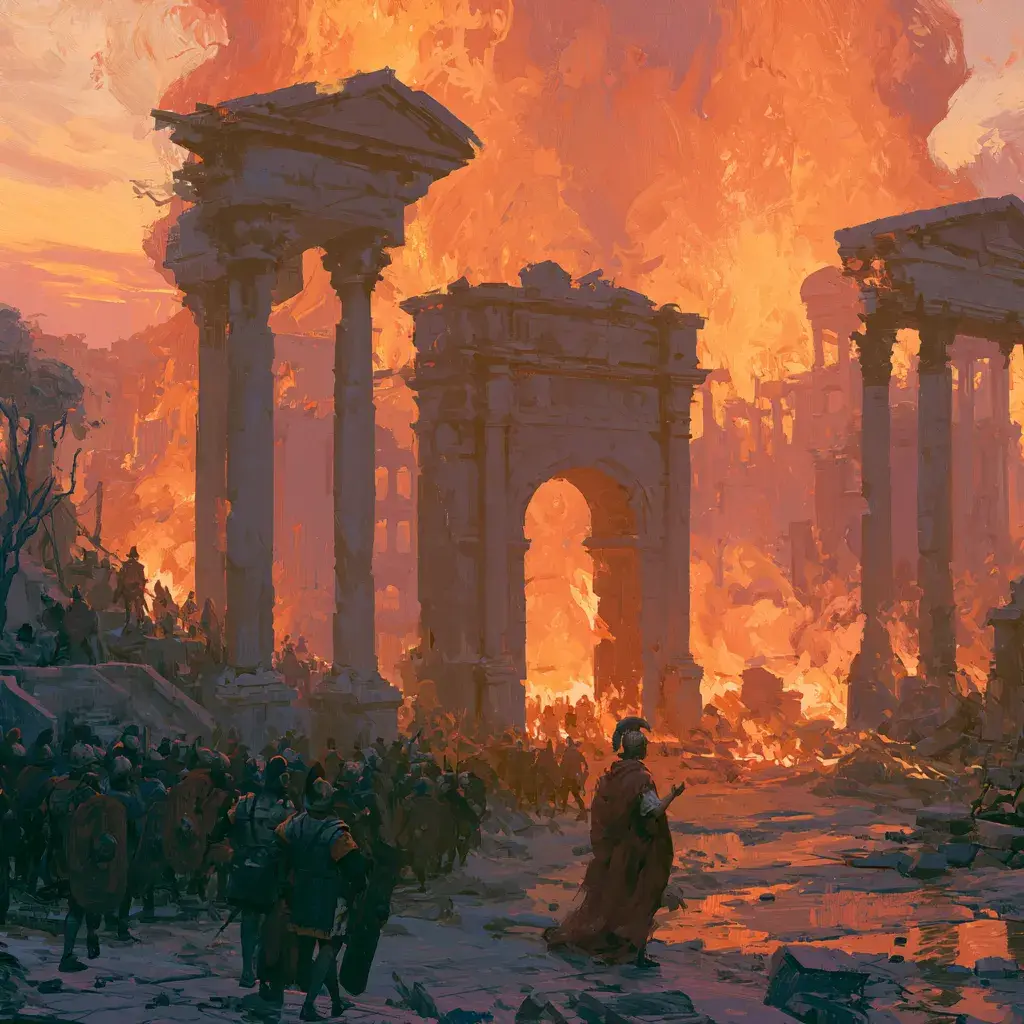 The Rise and Fall of the Roman EmpireHow Rome grew from a Republic into a vast empire, and why its western half fell in 476 while the east endured until 1453.
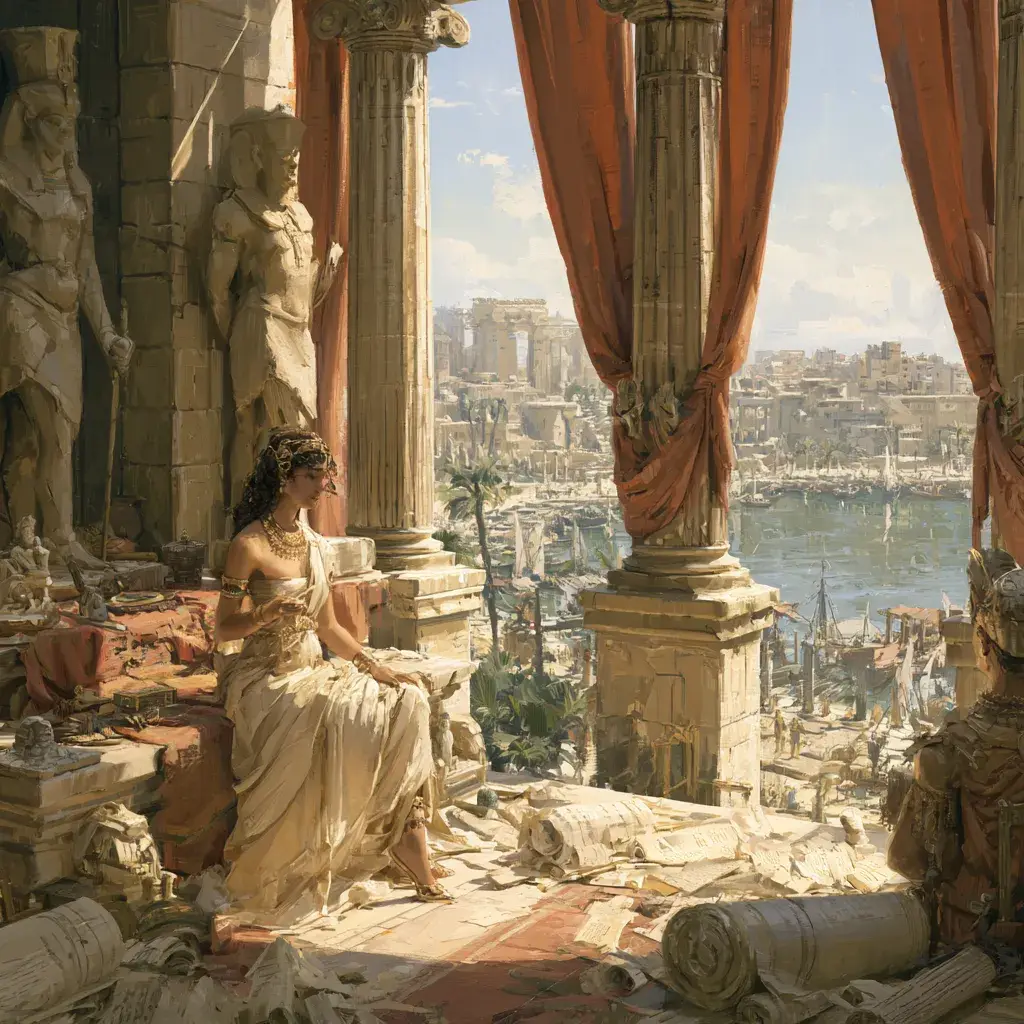 CleopatraHow Cleopatra, Egypt's last pharaoh, used her wits and alliances to rule, keep her kingdom independent, and challenge the might of Rome.
Continue Augustus's story
You've read the summary — hear the full story as narrated 5-minute chapters on Chunks, alongside 200+ figures and events from history, philosophy and science. Free to start on iOS and Android.