
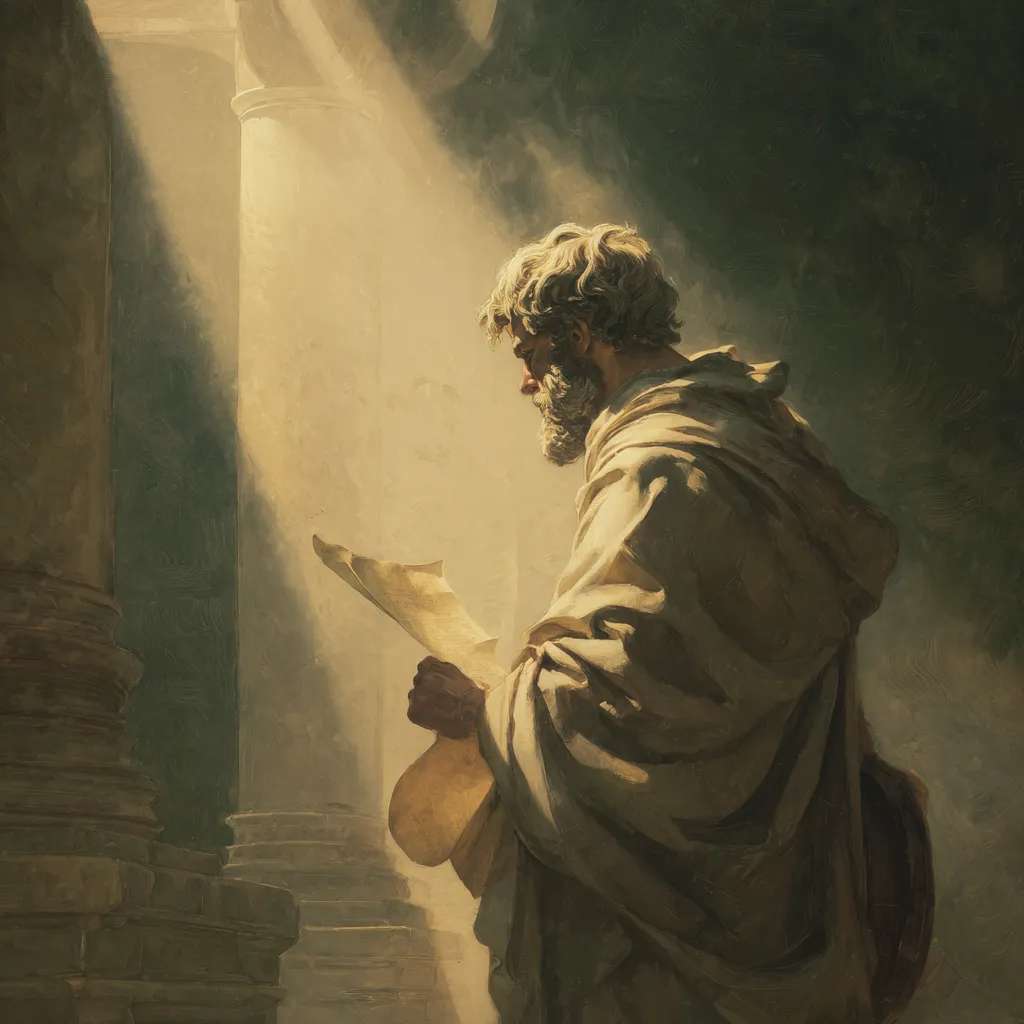
Who was Aristotle?
Aristotle (384–322 BC) was an ancient Greek philosopher and polymath who studied at Plato's Academy in Athens before founding his own school, the Lyceum. He made foundational contributions to logic, ethics, politics, biology, and natural science, and established the Peripatetic school of philosophy. His writings shaped medieval scholarship and laid groundwork for the development of modern science.
Ancient Greek philosopher and student of Plato who founded the Lyceum and made foundational contributions to logic, ethics, politics, and natural sciences. His teachings on virtue ethics and the 'Golden Mean' continue to influence moral philosophy today.
Don't stop at the facts — continue Aristotle's story in free narrated chapters on Chunks.
 Download on iOS
 Download on Android
Quick facts
- Born
- 384 BC
- Birthplace
- Stageira
- Died
- 322 BC
- Place of death
- Chalcis
- Occupation
- Philosopher, biologist, cosmologist
Aristotle: key facts
- Aristotle was born in 384 BC in Stagira, a city in Chalkidiki in northern Greece, and died in 322 BC in Chalcis, Euboea.
- At around age 17 or 18, Aristotle moved to Athens to study at Plato's Academy, where he remained for nearly 20 years and earned the nickname 'mind of the school' from Plato.
- Beginning in 343 BC, Aristotle tutored the 13-year-old Alexander the Great at the private school of Mieza, near the Macedonian capital Pella, at the request of King Philip II.
- Aristotle founded the Peripatetic school of philosophy at the Lyceum in Athens, a rented building that included a gymnasium and a colonnade called the peripatos, from which the school took its name.
- His logical works were compiled into a six-book collection called the Organon around 40 BC by Andronicus of Rhodes, and his influence on Western logic persisted well into the 19th century.
- Aristotle is credited with the first systematic study of biology, spending two years observing zoology on the island of Lesbos and producing works including History of Animals and Generation of Animals.
- Medieval Muslim scholars revered Aristotle as 'The First Teacher', while the Christian scholastic Thomas Aquinas referred to him simply as 'The Philosopher'.
From Stagira to Plato's Academy: Aristotle's Formation
Aristotle was born in 384 BC in Stagira, a city in Chalcidice in northern Greece, roughly 55 kilometers east of what is now Thessaloniki. His father, Nicomachus, served as personal physician to King Amyntas of Macedon, and ancient tradition held that the family traced its lineage to the legendary healer Asclepius. Both of Aristotle's parents died while he was still young, and a man named Proxenus of Atarneus became his guardian.
At around seventeen or eighteen years old, Aristotle traveled to Athens to study at Plato's Academy, where he would remain for nearly twenty years. He distinguished himself quickly enough that Plato reportedly called him the 'mind of the school.' When Plato died around 347 BC, Aristotle departed Athens, possibly because of dissatisfaction with the new direction of the Academy under Plato's nephew Speusippus, or possibly because anti-Macedonian sentiment in the city made his position uncomfortable. He relocated to Assos in Asia Minor at the invitation of Hermias of Atarneus, a former fellow student, and there he married Hermias's adoptive daughter Pythias.
Tutoring Alexander and Returning to Athens
In 343 BC, Philip II of Macedon invited Aristotle to tutor his thirteen-year-old son Alexander. Aristotle taught the young prince at the private school of Mieza, near the Macedonian capital Pella, covering subjects that likely ranged from ethics and politics to literary texts such as Homer and Euripides. Other prominent figures in the Macedonian court, including Ptolemy and Cassander, are thought to have occasionally attended his lectures. Aristotle is said to have given Alexander an annotated copy of the Iliad that Alexander treasured throughout his life.
Aristotle returned to Athens for the final time a year after Philip II's assassination in 336 BC. Because he was a metic — a resident foreigner — he could not own property in Athens, so he rented a complex of buildings known as the Lyceum, named after a nearby grove sacred to Apollo. There he established his own school, which came to be called the Peripatetic school after the colonnade, or peripatos, that formed part of the grounds. He ran the school for twelve years, building a substantial library with manuscripts, maps, and other objects, while composing the majority of his surviving philosophical works.
Logic, Metaphysics, and the Science of Living Things
Aristotle's contribution to logic was so comprehensive that the philosopher Immanuel Kant later declared it had reached completion with him. Aristotle's logical writings were collected into a set of six books called the Organon, compiled around 40 BC by Andronicus of Rhodes. These ranged from the analysis of basic terms and propositions through to the study of syllogisms and the detection of fallacious arguments. His framework dominated Western logical thought until the development of mathematical logic in the nineteenth century.
In metaphysics, Aristotle rejected his teacher Plato's view that universal forms exist in a separate realm. For Aristotle, the form of something exists within the particular thing itself — the form of an apple exists inside each individual apple, not in some separate world of ideal objects. He further developed the concepts of potentiality and actuality to explain change: a seed is potentially a plant, and the fully grown plant represents the actualization of that potential.
Biology occupied a remarkable portion of Aristotle's attention. He spent two years on the island of Lesbos making direct observations of marine and animal life, and the resulting works represent the first systematic attempt to study living things scientifically. He distinguished roughly 500 animal species, described the four-chambered stomachs of ruminants, and offered accurate accounts of the reproductive biology of sharks. Charles Darwin later regarded Aristotle as the most important contributor to the field of biology, writing that figures such as Linnaeus and Cuvier were 'mere schoolboys to old Aristotle.'
Ethics, Politics, and the Purpose of Human Life
Aristotle approached ethics as a practical discipline aimed at actually becoming good, not merely understanding what goodness is. In the Nicomachean Ethics, he argued that every human action aims at some good, and that the highest human good is eudaimonia — a word often translated as happiness but carrying the broader sense of a life that is flourishing and well-lived. Achieving this required the cultivation of virtue, which Aristotle understood as finding the appropriate middle ground between extremes of excess and deficiency in any given area of conduct.
His political philosophy extended these ideas outward. In the Politics, he argued that humans are by nature political animals, and that the city-state exists not merely to prevent injustice or ensure economic survival but to enable its citizens to live well and perform admirable acts. He was critical of pure democracy and explored how elements of different constitutional arrangements could be blended into a stable mixed system. These works shaped centuries of subsequent thinking in both the Islamic world, where scholars called him the 'First Teacher,' and in medieval Christian Europe, where Thomas Aquinas referred to him simply as 'The Philosopher.'
Death, Transmission, and Enduring Influence
Following the death of Alexander the Great in 323 BC, anti-Macedonian feeling surged in Athens. Aristotle was denounced for impiety by Demophilus and Eurymedon the Hierophant and chose to flee rather than face trial, reportedly remarking that he would not allow the Athenians to sin twice against philosophy — a reference to the earlier execution of Socrates. He withdrew to his mother's family estate in Chalcis, on the island of Euboea, where he died of natural causes in 322 BC. In his will he asked to be buried beside his wife Pythias, and he left his works to his successor Theophrastus.
Theophrastus passed Aristotle's manuscripts to Neleus of Scepsis, where they were kept hidden before eventually being purchased by a collector named Apellicon. In the meantime, copies of the major works had already begun circulating in Athens, Alexandria, and Rome. Aristotle's writings were translated into Arabic during the Abbasid Caliphate and became the foundation for major Islamic thinkers including Ibn Sina and Averroes, before returning to Latin Europe in the twelfth and thirteenth centuries. His influence spread across logic, biology, ethics, political theory, rhetoric, and theology — a range that led the philosopher Bryan Magee to write that it was doubtful any human being had ever known as much as Aristotle did.
Aristotle: timeline
- 384 BCBorn in Stagira, Chalcidice, the son of Nicomachus, personal physician to King Amyntas of Macedon.
- c. 367–347 BCMoved to Athens at around age seventeen or eighteen to study at Plato's Academy, where he remained for nearly twenty years.
- 348/47 BCLeft Athens after Plato's death, departing with Xenocrates to Assos in Asia Minor at the invitation of Hermias of Atarneus.
- 343/42 BCInvited by Philip II of Macedon to tutor his thirteen-year-old son Alexander at the private school of Mieza near Pella.
- 335 BCReturned to Athens and established his own school at the Lyceum, founding the Peripatetic school of philosophy.
- 335–323 BCComposed many of his major philosophical treatises at the Lyceum, including Physics, Metaphysics, Nicomachean Ethics, Politics, On the Soul, and Poetics.
- 322 BCFled Athens to his mother's family estate in Chalcis, Euboea after being denounced for impiety, and died there of natural causes the same year.
Listen: stories featuring Aristotle
Narrated chapters from the Chunks Microlearning app. Read a preview here, or listen to the full story in the app.

Continue Aristotle's story
You've read the summary — hear the full story as narrated 5-minute chapters on Chunks, alongside 200+ figures and events from history, philosophy and science. Free to start on iOS and Android.