
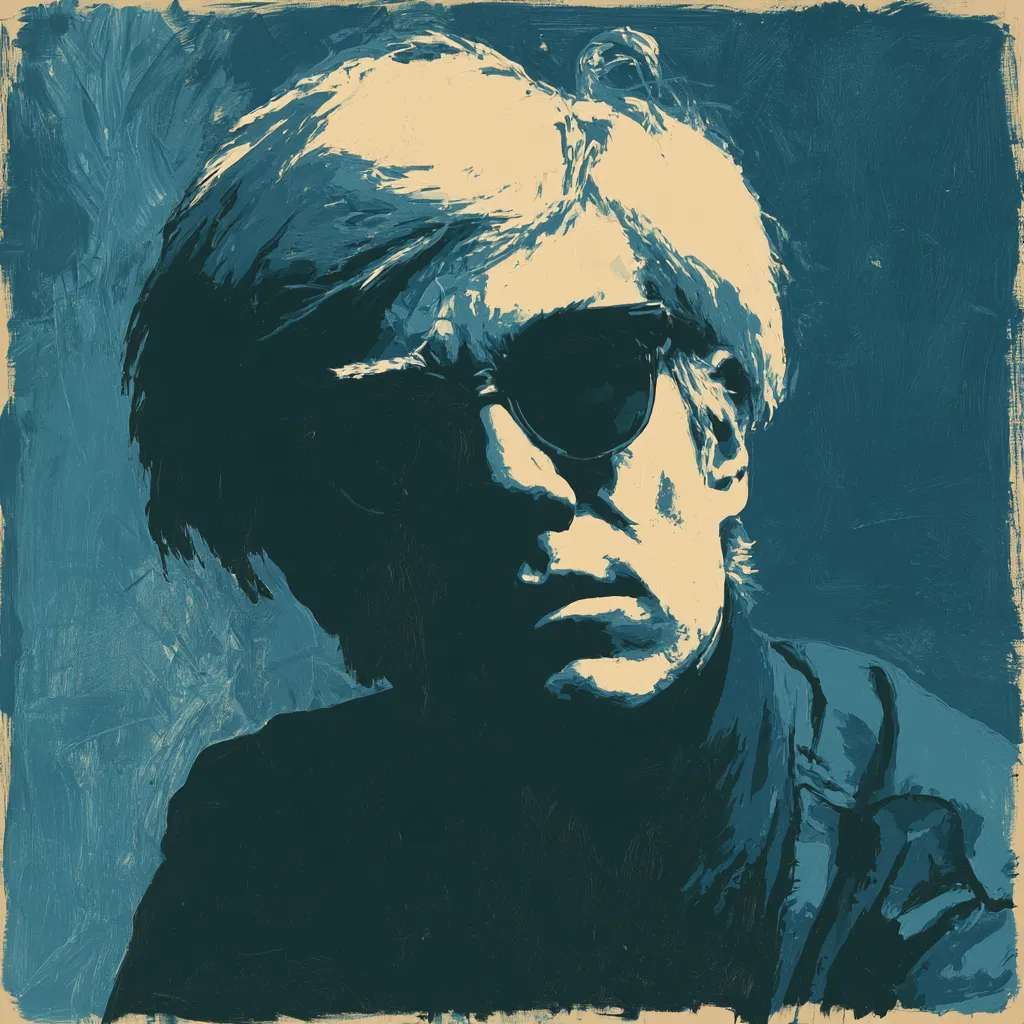
Who was Andy Warhol?
Andy Warhol (August 6, 1928 – February 22, 1987) was an American painter, filmmaker, and photographer widely regarded as the most important artist of the second half of the 20th century. A leading figure in the Pop art movement, he transformed everyday consumer imagery into fine art through silkscreen paintings of subjects like Campbell's Soup cans and celebrity portraits of Marilyn Monroe and Elvis Presley.
American artist and leading figure of the Pop Art movement who transformed commercial imagery into fine art. His silkscreen paintings of celebrities and consumer products redefined what art could be in the modern world.
Don't stop at the facts — continue Andy Warhol's story in free narrated chapters on Chunks.
Or get it straight away:
 Download on iOS
 Download on Android
Quick facts
- Born
- 6 August 1928
- Birthplace
- Pittsburgh
- Died
- 22 February 1987
- Place of death
- New York City
- Nationality
- United States
- Occupation
- Film director, painter, photographer
Andy Warhol: key facts
- Andy Warhol was born Andrew Warhola Jr. on August 6, 1928, in Pittsburgh, Pennsylvania, to Rusyn immigrant parents who had emigrated from what is now northeast Slovakia.
- Warhol's breakthrough came in July 1962 when the Ferus Gallery in Los Angeles exhibited his 32 Campbell's Soup Cans paintings, each depicting a different variety of the soup.
- In 1964, Warhol established his legendary studio at 231 East 47th Street in New York City, which became known as the Factory and served as a hub for avant-garde artists, musicians, and celebrities.
- On June 3, 1968, radical feminist writer Valerie Solanas shot Warhol at the Factory; he was hospitalized for nearly two months and required a surgical corset for the rest of his life.
- In May 2022, Warhol's silkscreen painting Shot Sage Blue Marilyn (1964) sold at Christie's for $195 million, the highest price ever paid at auction for a work by an American artist.
- Warhol died on February 22, 1987, at age 58 from sudden cardiac arrhythmia following gallbladder surgery at New York Hospital.
- The Andy Warhol Museum in Pittsburgh, which opened in 1994, holds the largest collection of Warhol's works in the world and is the largest US museum dedicated to a single artist.
From Pittsburgh to New York: A Commercial Artist Finds His Footing
Andy Warhol was born Andrew Warhola Jr. on August 6, 1928, in Pittsburgh, Pennsylvania, the fourth child of Rusyn immigrant parents who had come to the United States from what is now northeast Slovakia. His father worked in a coal mine, and the family attended a Byzantine Catholic church. As a child, Warhol suffered a neurological condition called Sydenham's chorea, which left him bedridden for stretches of time. During those days at home he drew, made scrapbooks from Hollywood magazines, and developed an early passion for photography. His father and brothers built him a darkroom in the basement after noticing his interest.
After winning a scholarship to the Carnegie Institute of Technology in Pittsburgh, Warhol earned a Bachelor of Fine Arts in pictorial design in 1949 and moved to New York City with a classmate. Within days of arriving, he visited the art director of Glamour magazine, who purchased a small drawing and soon commissioned him to produce shoe illustrations. Those illustrations marked the beginning of a career in commercial art. Through the 1950s, Warhol worked for Glamour, Vogue, Harper's Bazaar, and Mademoiselle, and became widely recognized for his whimsical shoe drawings for the manufacturer I. Miller. He won the Art Directors Club Award for Distinctive Merit in 1956, by which point he was so in demand that he had to turn down assignments.
Campbell's Soup Cans and the Breakthrough into Pop Art
Around 1961, Warhol began shifting from commercial illustration to fine art, experimenting with paintings based on comic strips and advertisements. His early Pop canvases were first displayed publicly in the window of the Bonwit Teller department store on Fifth Avenue. He struggled to find gallery representation, with dealers including Leo Castelli declining his work. The turning point came when he adopted the silkscreen printing process in 1962, which allowed him to transfer photographic images onto canvas in a way that deliberately evoked an assembly-line effect rather than traditional hand-painting.
His 32 paintings of Campbell's Soup cans, each depicting a different variety, were shown at the Ferus Gallery in Los Angeles in July 1962, marking his West Coast debut. That same year, his first solo New York Pop exhibition opened at the Stable Gallery and included Marilyn Monroe portraits, dollar bills, and Coca-Cola bottles. Art critic Michael Fried wrote that Warhol was probably the most single-minded and spectacular of all painters working with popular imagery. By December 1962, the Museum of Modern Art was hosting symposiums debating his work, and critics were divided over whether his embrace of consumer culture was a genuine artistic statement or a capitulation to commerce.
The Factory: Silver Walls, Superstars, and Underground Films
By 1964, Warhol had established his studio at 231 East 47th Street, a space that became known as the Factory. It was covered in aluminum foil and silver paint and served as a gathering point for drag queens, poets, musicians, and wealthy patrons. Warhol used assistants, most notably poet Gerard Malanga, to help produce silkscreens and films, and this collaborative method remained central to how he worked for the rest of his career. The Factory attracted a loose constellation of personalities Warhol called superstars, including Edie Sedgwick, Candy Darling, Ultra Violet, and Viva, who appeared in his films.
Between 1963 and 1968, Warhol produced more than 600 films. His early experimental works were minimalist studies in duration: Sleep, made in 1964, documented a man sleeping for over five hours, while Empire, released in 1965, consisted of an eight-hour static shot of the Empire State Building. Chelsea Girls, made in 1966, used dual projections running simultaneously and became the first underground film of the decade to achieve widespread critical attention. Warhol also managed the experimental rock band the Velvet Underground, financing their debut album The Velvet Underground and Nico in 1967 and staging the Exploding Plastic Inevitable multimedia performances in 1966 and 1967.
Surviving the Shooting and Reinventing the Factory as a Business
On June 3, 1968, radical feminist writer Valerie Solanas shot Warhol at the Factory. He was seriously wounded and remained in hospital for nearly two months. Solanas, who had appeared in one of his films, was later diagnosed with paranoid schizophrenia and sentenced to three years in prison. The attack left lasting physical damage: complications from a subsequent operation meant Warhol had to wear a surgical corset for the rest of his life. The experience transformed the Factory from a freewheeling social scene into a more regulated business operation.
In the years that followed, Warhol founded Interview magazine in 1969 with journalist John Wilcock, published The Philosophy of Andy Warhol in 1975, and produced the play Pork. He resumed painting with new series including Mao in 1972 and 1973, and developed a lucrative portrait practice, charging $25,000 for a commissioned portrait. He became a fixture at Studio 54 after it opened in April 1977, socializing with Halston, Bianca Jagger, and Liza Minnelli. He also expanded into television with Andy Warhol's TV, which ran from 1980 to 1983, and the MTV talk show Andy Warhol's Fifteen Minutes, which ran from 1985 to 1987.
Death, Auction Records, and a Market That Kept Rising
Warhol had been diagnosed with a gallstone as early as 1973 but avoided surgery because he feared hospitals. By February 1987 he was dehydrated and in severe pain. He was admitted to New York Hospital on February 20, underwent gallbladder surgery the following day, and died in the early hours of February 22 from sudden cardiac arrhythmia. He was 58. A subsequent New York State Health Department report found that the hospital had provided inadequate care, and in 1991 his family sued for malpractice. The case was settled out of court for an undisclosed sum.
Following his death, the value of Warhol's work rose dramatically and consistently. In 2013, his diptych Silver Car Crash sold for $105 million at Sotheby's. In May 2022, Shot Sage Blue Marilyn, a 1964 portrait of Marilyn Monroe, sold for $195 million at Christie's, making it the most expensive work by an American artist ever sold at auction. Warhol's estate was used to establish the Andy Warhol Foundation for the Visual Arts in 1987, which became one of the largest grant-giving organizations for the visual arts in the United States. The Andy Warhol Museum, which opened in Pittsburgh in 1994, holds the largest collection of his work in the world.
Andy Warhol: timeline
- 1928Born Andrew Warhola Jr. in Pittsburgh, Pennsylvania, the fourth child of Rusyn immigrant parents from what is now Slovakia.
- 1949Graduated from the Carnegie Institute of Technology with a Bachelor of Fine Arts and moved to New York City, beginning a career as a commercial illustrator.
- 1952Held his first solo exhibition, fifteen drawings based on the writings of Truman Capote, at the Hugo Gallery in New York.
- 1962Debuted his Campbell's Soup Cans paintings at the Ferus Gallery in Los Angeles, establishing himself as a leading figure in the emerging Pop art movement.
- 1964Relocated his studio to 231 East 47th Street, which became known as the Factory, a hub for avant-garde artists, musicians, and bohemian culture.
- 1966Began managing the Velvet Underground and staged the Exploding Plastic Inevitable multimedia performances, financing the band's debut album.
- 1968Radical feminist Valerie Solanas shot and nearly killed Warhol at the Factory; he spent nearly two months in hospital and wore a surgical corset for the rest of his life.
- 1969Co-founded Interview magazine with journalist John Wilcock, initially focused on film before evolving into a celebrity culture publication.
- 1975Published The Philosophy of Andy Warhol, articulating his philosophy of business art and consumer culture.
- 1987Died of sudden cardiac arrhythmia in New York City at age 58, following gallbladder surgery at New York Hospital.
Listen: stories featuring Andy Warhol
Narrated chapters from the Chunks Microlearning app. Read a preview here, or listen to the full story in the app.
.webp?v=1769092297192)
Continue Andy Warhol's story
You've read the summary — hear the full story as narrated 5-minute chapters on Chunks, alongside 200+ figures and events from history, philosophy and science. Free to start on iOS and Android.