
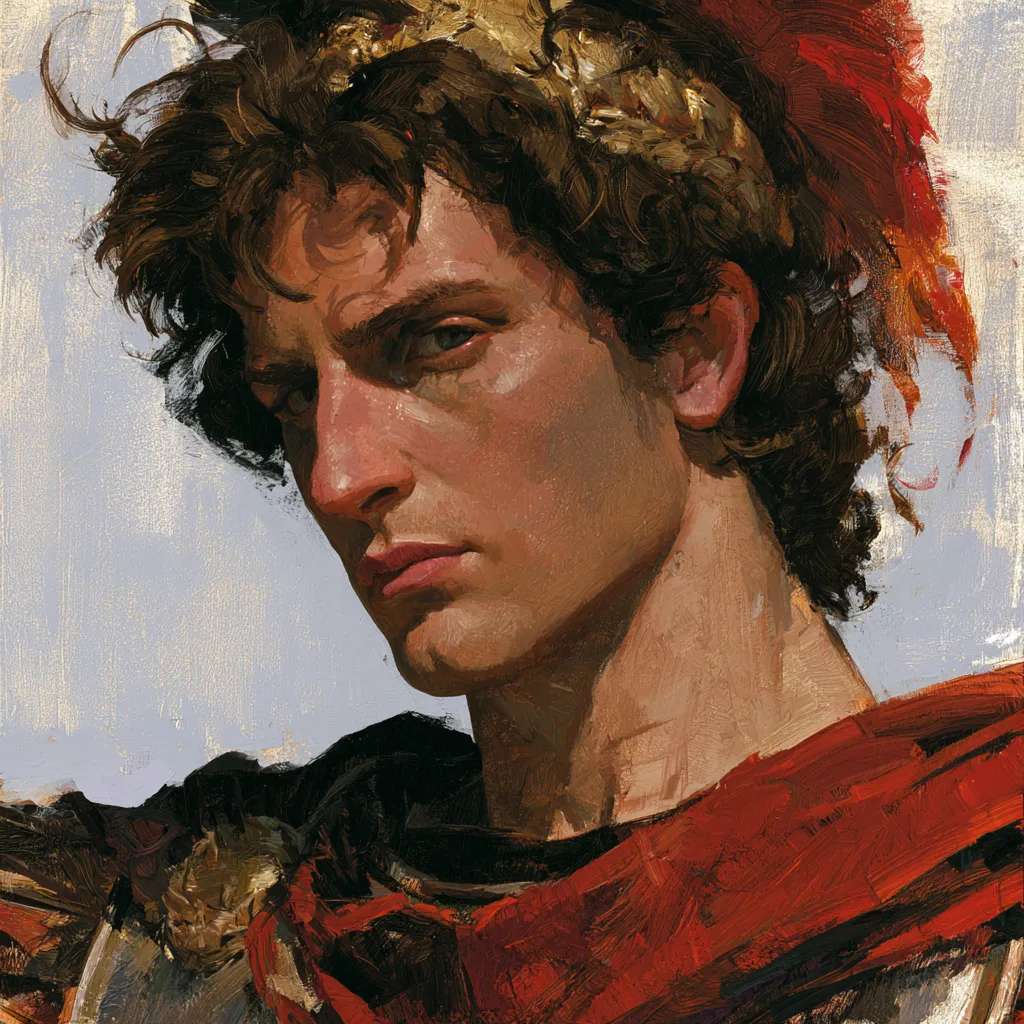
Who was Alexander the Great?
Alexander the Great (356-323 BC) was king of Macedon who became one of history's most successful military commanders, conquering the Persian Empire and building a realm stretching from Greece to northwestern India by age 30. Born in Pella, he was tutored by Aristotle before succeeding his father Philip II. Undefeated in battle, he died in Babylon, and his conquests spread Greek culture widely, ushering in the Hellenistic age.
Alexander the Great was King of Macedonia who created one of the largest empires in ancient history by age 30. His conquests spread Greek culture across three continents and reshaped the ancient world.
Don't stop at the facts — continue Alexander the Great's story in free narrated chapters on Chunks.
Or get it straight away:
 Download on iOS
 Download on Android
Quick facts
- Born
- 356 BC
- Birthplace
- Pella
- Died
- 323 BC
- Place of death
- Babylon
- Nationality
- Macedonia
- Occupation
- Politician, military leader, monarch
Alexander the Great: key facts
- Alexander III of Macedon was born in Pella on 20 or 21 July 356 BC to King Philip II and Queen Olympias.
- He succeeded his father Philip II as king of Macedon in 336 BC at the age of 20 after Philip was assassinated at Aigai.
- Alexander studied under the philosopher Aristotle at Mieza from around age 13 until 16.
- After destroying Thebes in 335 BC for rebelling against Macedonian rule, Alexander led the League of Corinth into a ten-year invasion of the Persian Achaemenid Empire starting in 334 BC.
- He defeated Persian King Darius III in major battles at Issus in 333 BC and Gaugamela in 331 BC, effectively ending Achaemenid rule.
- In 326 BC he defeated King Porus at the Battle of the Hydaspes in present-day Punjab before his troops mutinied at the Beas River and forced him to turn back.
- Alexander died in Babylon on 10 or 11 June 323 BC at age 32, and his empire fragmented among his generals, known as the Diadochi, after his death.
A Macedonian Prince Groomed for Greatness
Alexander was born in Pella, the capital of Macedon, in 356 BC, the son of King Philip II and his wife Olympias, a princess of Epirus. Ancient writers surrounded his birth with omens and legends, including stories of prophetic dreams that later fed claims of divine parentage, claims that may have been encouraged once Alexander became king. As a boy he was raised by a nurse, Lanike, and tutored first by the strict Leonidas and by Lysimachus of Acarnania, learning to read, play the lyre, ride, fight, and hunt in the manner expected of Macedonian nobility. A well-known story credits the ten-year-old Alexander with taming a wild horse that no one else could ride, which Philip then bought for him; Alexander named the horse Bucephalas, and it carried him on campaign as far as India.
When Alexander turned thirteen, Philip brought in the philosopher Aristotle to tutor him, setting up a classroom at the Temple of the Nymphs at Mieza. Alongside him studied other young Macedonian nobles, including Ptolemy, Hephaestion, and Cassander, many of whom later became his generals and closest companions. Under Aristotle, Alexander studied medicine, philosophy, religion, logic, and art, and developed a lifelong devotion to Homer's Iliad, carrying an annotated copy with him on his campaigns. The Macedonian court also hosted Persian exiles during these years, giving Alexander early exposure to Persian affairs that may have shaped his later approach to ruling a vast, multicultural empire.
Taking the Macedonian Throne
At sixteen, Alexander's formal education ended and he was left as regent while Philip campaigned against Thrace. When a Thracian tribe revolted, Alexander put down the rebellion himself and founded a city, Alexandropolis, in the process. He later distinguished himself commanding the left wing at the Battle of Chaeronea in 338 BC, where Macedon crushed the combined forces of Athens and Thebes and Philip established the League of Corinth to unite the Greek states under his leadership. Alexander's position as heir was complicated when Philip married Cleopatra Eurydice, prompting a furious confrontation between father and son at the wedding banquet and a period of exile for Alexander before the two reconciled.
Philip was assassinated in 336 BC at Aigai, and the army and nobility immediately proclaimed the twenty-year-old Alexander king. He moved quickly to eliminate rivals to the throne and to suppress revolts that broke out across Greece and the Balkans at the news of Philip's death. He forced the surrender of Thessaly, was recognized as leader of the Greek alliance at Corinth, and then marched north to crush uprisings among the Thracians and Illyrians, securing his northern frontier. When Thebes rebelled again while he was campaigning, Alexander turned south and destroyed the city entirely, an act that frightened the rest of Greece into submission and left him free to turn his attention to Persia.
Breaking the Persian Empire
In 334 BC Alexander crossed into Asia Minor with roughly 48,000 infantry and 6,100 cavalry, launching a campaign against the Achaemenid Persian Empire that would last a decade. He defeated Persian forces at the Granicus River, then swept along the Ionian coast freeing Greek cities before winning a difficult siege at Halicarnassus. Moving through Lycia and Pamphylia, he cut off Persian naval bases and, at Gordium, famously cut through the legendary Gordian Knot with his sword. In 333 BC he defeated the Persian king Darius III himself at the Battle of Issus, capturing Darius's family and treasury as the Persian king fled the field.
Alexander then turned toward the Levant and Egypt, taking Tyre after a grueling siege and Gaza after repeated assaults. In Egypt he was welcomed as a liberator, crowned in the ancient manner at Memphis, and pronounced son of the god Amun after visiting the oracle at Siwa; he also founded the city of Alexandria, which became one of the great cities of the ancient world. Returning to Mesopotamia in 331 BC, he won his decisive victory over Darius at Gaugamela, then occupied Babylon and Susa before storming Persepolis, the Persian ceremonial capital, where his troops looted the city and a fire later destroyed much of it. Darius fled eastward and was eventually murdered by his own kinsman Bessus, who claimed the throne; Alexander pursued and had Bessus executed, effectively ending Achaemenid rule and treating himself as its rightful successor.
Into Central Asia and India
Alexander spent several years subduing fierce resistance across Central Asia, founding new cities along the way, including one in what is now Afghanistan and another, Alexandria Eschate, in modern Tajikistan. During this period he adopted elements of Persian dress and court custom, including the practice of proskynesis, a gesture of submission that many of his Macedonian followers found offensive and un-Greek, costing him support among his own men. Tensions boiled over into conspiracies against his life, leading to the execution of the general Philotas and the killing of his father Parmenion, and, in a drunken quarrel, Alexander personally killed his old friend Cleitus the Black, who had once saved his life in battle.
In 327 BC Alexander pushed into the Indian subcontinent, fighting hard campaigns against hill tribes in the Kunar and Swat valleys before crossing the Indus. He won a major victory over the local king Porus at the Battle of the Hydaspes in 326 BC, then reinstated Porus as an ally and expanded his territory rather than removing him. Alexander pressed on toward the Ganges plain, but his exhausted army, having fought for years far from home, mutinied at the Hyphasis River and refused to advance further, forcing him to turn back. The retreat home was costly, including a near-fatal wound Alexander suffered during fighting in the Mallian campaign and heavy losses to his forces crossing the harsh Gedrosian desert.
Death in Babylon and the Empire's Collapse
Back in Persia, Alexander executed several governors accused of misrule, paid off his soldiers' debts, and tried to send aging veterans home, a decision his troops misread as a slight that triggered a mutiny at Opis, which he resolved by folding Persian soldiers into the Macedonian ranks. He staged mass marriages between his officers and Persian noblewomen at Susa in an effort to blend his Macedonian and Persian subjects, though most of these unions did not last. The death of his closest companion Hephaestion at Ecbatana devastated him, and ancient writers suggest his health and state of mind declined sharply afterward as he planned further campaigns, including an invasion of Arabia.
Alexander died in Babylon in 323 BC at the age of thirty-two, after an illness lasting less than two weeks. Ancient historians disagreed even at the time about the cause, with some suspecting poison and others favoring natural disease, and neither explanation has ever been confirmed. He left no clear adult heir, and his empire was divided among his generals, the Diadochi, whose decades of civil war eventually split his conquests into separate Hellenistic kingdoms in Egypt, Syria and Persia, and Macedonia itself. Despite the empire's fragmentation, Alexander's campaigns spread Greek language and culture across a vast stretch of Asia and North Africa, seeding the Hellenistic civilization that shaped the Mediterranean and Near East for centuries afterward.
Alexander the Great: timeline
- 356 BCBorn in Pella, the capital of Macedon, son of King Philip II and Olympias.
- 343 BCBegan studying under the philosopher Aristotle at Mieza, alongside future generals such as Ptolemy and Hephaestion.
- 340 BCServed as regent of Macedon at age 16 while Philip campaigned abroad, and crushed a revolt by the Thracian Maedi.
- 338 BCCommanded the left wing of the Macedonian army at the Battle of Chaeronea, helping secure Macedonian dominance over the Greek city-states.
- 336 BCBecame king of Macedon at age 20 after Philip II was assassinated at Aigai.
- 335 BCDestroyed the city of Thebes after it rebelled against Macedonian rule, subduing renewed unrest in Greece.
- 334 BCCrossed the Hellespont into Asia Minor and defeated Persian forces at the Battle of the Granicus, beginning his conquest of the Achaemenid Empire.
- 333 BCDefeated King Darius III at the Battle of Issus, capturing the Persian royal family after Darius fled the field.
- 332-331 BCTook Egypt after besieging Tyre and Gaza, was hailed as pharaoh, and founded the city of Alexandria.
- 331 BCBroke the power of the Persian Empire decisively at the Battle of Gaugamela, later occupying Babylon and Persepolis.
- 326 BCDefeated King Porus at the Battle of the Hydaspes in India before his army mutinied at the Hyphasis River and forced him to turn back.
- 323 BCDied in Babylon at age 32, leaving no clear heir and triggering decades of conflict among his successors.
Listen: stories featuring Alexander the Great
Narrated chapters from the Chunks Microlearning app. Read a preview here, or listen to the full story in the app.
Frequently asked questions about Alexander the Great
Who was Alexander the Great?
Alexander the Great was King of Macedonia from 336 to 323 BCE who built one of history's largest empires, stretching from Greece to India. He is considered one of the most successful military commanders in history, never having lost a battle.
What empire did Alexander the Great build?
Alexander the Great conquered the Persian Empire and extended his rule across Egypt, the Middle East, and into parts of India. His empire spread Greek language, culture, and ideas across a vast territory, a process known as Hellenization.
How did Alexander the Great die?
Alexander the Great died in Babylon in 323 BCE at the age of 32, likely from fever or illness, though the exact cause remains debated. His empire fragmented into several kingdoms ruled by his generals after his death.
Continue Alexander the Great's story
You've read the summary — hear the full story as narrated 5-minute chapters on Chunks, alongside 200+ figures and events from history, philosophy and science. Free to start on iOS and Android.