
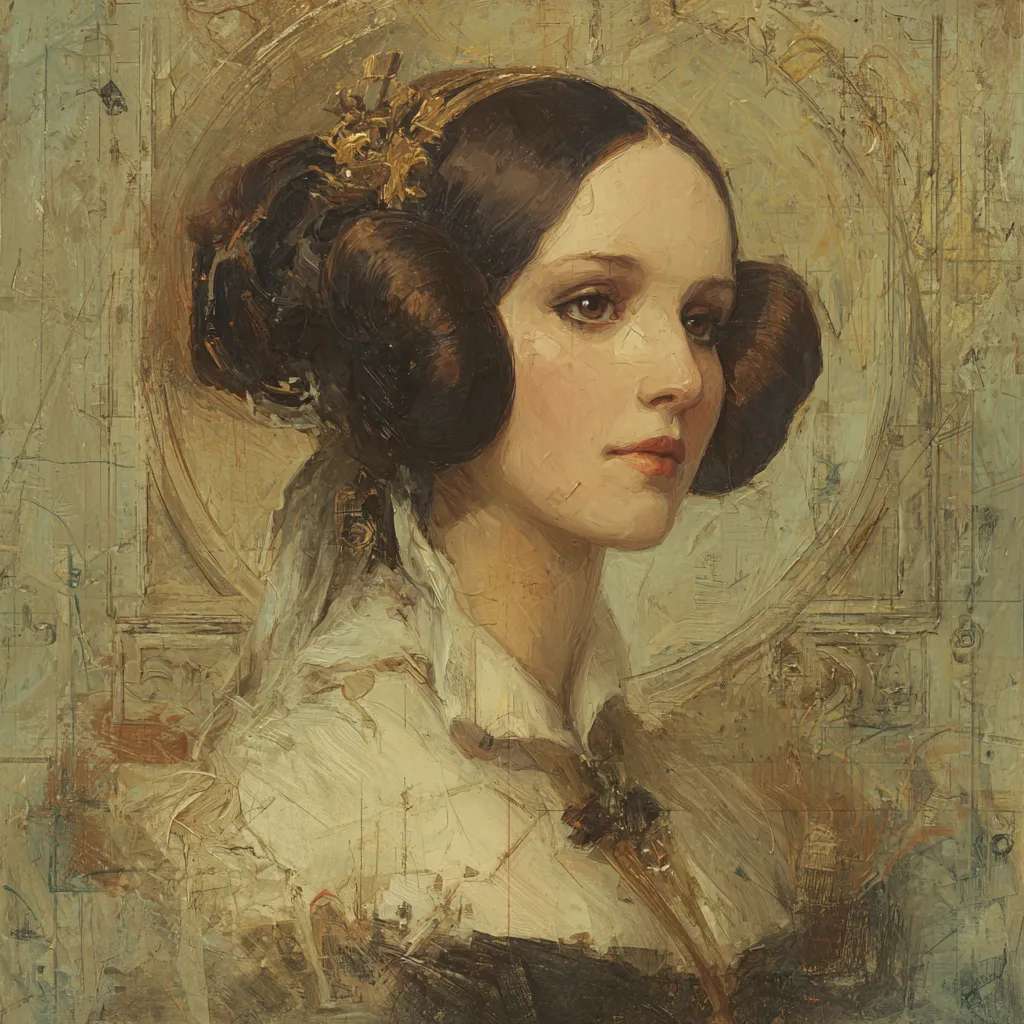
Who was Ada Lovelace?
Augusta Ada King, Countess of Lovelace (10 December 1815 – 27 November 1852), known as Ada Lovelace, was an English mathematician who collaborated with Charles Babbage on his proposed Analytical Engine. She translated a French article about the machine and added seven extensive notes, one of which described a method for calculating Bernoulli numbers now often called the first published computer program.
British mathematician who wrote the first computer algorithm and is considered the world's first computer programmer. Her visionary work with Charles Babbage's Analytical Engine in the 1840s laid the theoretical foundation for modern computing.
Don't stop at the facts — continue Ada Lovelace's story in free narrated chapters on Chunks.
 Download on iOS
 Download on Android
Quick facts
- Born
- 10 December 1815
- Birthplace
- London
- Died
- 27 November 1852
- Place of death
- Marylebone
- Nationality
- United Kingdom of Great Britain and Ireland
- Occupation
- Mathematician, programmer, poet
Ada Lovelace: key facts
- Ada Lovelace was born Augusta Ada Byron on 10 December 1815, the only legitimate child of the poet Lord Byron and Anne Isabella Milbanke.
- Between 1842 and 1843, Lovelace translated a French article about Charles Babbage's Analytical Engine by Luigi Menabrea, adding seven explanatory notes roughly three times longer than the original text.
- Note G of her translation described a detailed method for calculating Bernoulli numbers using the Analytical Engine, which is often called the first published computer program.
- Lovelace was the first to recognise that a computing machine could manipulate symbols beyond mere numbers, envisioning applications such as composing music, a century before modern computers realised this potential.
- She married William King in 1835, and when he was created 1st Earl of Lovelace in 1838, Ada became the Countess of Lovelace, the title by which she is best known.
- Babbage referred to Lovelace as 'The Enchantress of Number', and she described her own intellectual approach as 'poetical science', combining imagination with rigorous mathematical thinking.
- Lovelace died on 27 November 1852 at the age of 36 from cervical cancer, and was buried at her request beside her father at the Church of St. Mary Magdalene in Hucknall, Nottinghamshire.
Daughter of Byron, Raised on Mathematics
Augusta Ada Byron was born on 10 December 1815, the only legitimate child of the poet Lord Byron and his wife Anne Isabella Milbanke. Byron had expected a son and was disappointed. He named the girl after his half-sister Augusta Leigh. Within weeks of Ada's birth, Lady Byron departed for her parents' home at Kirkby Mallory at Lord Byron's command, taking the infant with her. Byron signed a deed of separation the following April and left England permanently. He died in April 1824 when Ada was eight years old.
Ada's upbringing was shaped by her mother's determination to suppress any trace of Byron's temperament in the child. Lady Byron ensured Ada was taught mathematics from an early age, partly out of a belief that rigorous logical training would guard against the instability she attributed to her father. Ada spent much of her childhood in the care of her maternal grandmother and was often ill — at eight she suffered headaches that obscured her vision, and a bout of measles in 1829 left her temporarily paralysed, confined to bed for nearly a year and dependent on crutches until 1831.
Despite persistent ill health, Ada pursued her studies with intensity. She was privately educated in mathematics and science by tutors including William Frend, William King, and the prominent scientific author Mary Somerville. Somerville became a close friend and would prove decisive in shaping Ada's intellectual future, introducing her to the circle of scientists and thinkers that defined early Victorian scientific life.
Meeting Babbage and the Analytical Engine
On 5 June 1833, Ada and her mother attended one of Charles Babbage's Saturday evening gatherings in London, introduced by Mary Somerville. Ada was seventeen. Later that month Babbage invited her to see the prototype of his Difference Engine, a mechanical calculating device. She was immediately fascinated. Babbage, in turn, was struck by her analytic ability and affectionately called her the 'Enchantress of Number.'
The machine that consumed most of Ada's attention was Babbage's more ambitious project, the Analytical Engine — a proposed general-purpose mechanical computer that was never actually built. In 1840, Babbage gave a seminar about it at the University of Turin. A young Italian engineer named Luigi Menabrea transcribed the lecture in French, and it was published in the Bibliothèque universelle de Genève in October 1842. Babbage's friend Charles Wheatstone then asked Ada to translate Menabrea's article into English.
During a nine-month period in 1842 and 1843, Ada translated the article and added seven lengthy explanatory notes of her own, labelled A through G, which together ran to roughly three times the length of the original text. The translation and notes appeared in the September 1843 edition of Taylor's Scientific Memoirs under her initials AAL. The scientist Michael Faraday described himself as a supporter of her writing.
Note G and the Question of the First Computer Program
The seventh note, Note G, described in complete detail a method for using the Analytical Engine to calculate a sequence of Bernoulli numbers. This algorithm is frequently called the first published computer program. The engine was never built, so the program was never run. Babbage's own unpublished notes from between 1837 and 1840 contain earlier programs for the engine, and he claimed credit for the algorithm in Note G in his autobiography, which has led to persistent debate about the extent of Ada's independent contribution.
The historian Allan Bromley concluded that all but one of the programs referenced in Ada's notes had been prepared by Babbage years earlier, and that the exception was prepared by Babbage for her, though she did detect a bug in it. Bruce Collier argued that Ada made a significant contribution to publicising the Analytical Engine without advancing its design or theory. Stephen Wolfram, by contrast, argued that Ada's treatment of the Bernoulli numbers calculation was more sophisticated and clearly presented than anything Babbage had produced, and that her principal achievement was distilling from Babbage's ideas a clean, abstract account of how the machine operated.
Whatever the precise division of credit for Note G, the broader significance of Ada's notes is less disputed. Doron Swade, a historian of computing, argued that Ada was the first person to articulate the transition from mere number-crunching to general-purpose computation — recognising that if numbers could represent things other than quantities, such as musical notes or letters, then a machine manipulating those numbers according to rules could operate on symbols of any kind. Note G also contains a passage that Alan Turing later named 'Lady Lovelace's Objection' in his paper on computing machinery and intelligence: her statement that the Analytical Engine had no power to originate anything, and could only do whatever it was ordered to perform.
Marriage, Household, and a Life Beyond Mathematics
On 8 July 1835, Ada married William King, who held the title of Baron. In 1838, he was created Earl of Lovelace and Viscount Ockham, making Ada the Countess of Lovelace. The title was chosen in part because Ada was descended from the extinct Barons Lovelace. The couple had three children: Byron, born in 1836; Anne Isabella, known as Annabella, born in 1837; and Ralph Gordon, born in 1839. Their homes included Ockham Park in Surrey, an estate on Loch Torridon in Ross-shire, and a London house.
Ada's adult life was not confined to scientific work. In the 1840s she developed a serious interest in gambling, apparently losing more than three thousand pounds on horse racing. She formed a syndicate with male associates and in 1851 attempted to construct a mathematical model for placing large bets successfully. The effort went badly wrong, leaving her thousands of pounds in debt and forcing her to confess the situation to her husband. She also maintained a long and somewhat shadowy relationship with John Crosse, the son of the electrical engineer Andrew Crosse, from 1844 onward; he destroyed most of their correspondence after her death as part of a legal agreement.
Death and Enduring Commemoration
Ada Lovelace died on 27 November 1852, aged 36, from cervical cancer. During her final months, Lady Byron took control of who was permitted to see her daughter, excluding most of Ada's friends and confidants. Under her mother's influence, Ada underwent a religious transformation and named Lady Byron as her executor. She was buried, at her own request, beside her father at the Church of St. Mary Magdalene in Hucknall, Nottinghamshire.
More than a century after her death, her notes on the Analytical Engine were republished in 1953 as an appendix to B. V. Bowden's Faster than Thought: A Symposium on Digital Computing Machines, bringing her work to a new audience in the early computer age. The programming language Ada, developed on behalf of the United States Department of Defense, was named in her honour; its reference manual was approved on 10 December 1980 and the associated military standard was given the number 1815, the year of her birth.
Ada Lovelace Day, celebrated annually on the second Tuesday of October, was established in 2009 to raise the profile of women in science, technology, engineering, and mathematics. The British Computer Society has awarded the Lovelace Medal since 1998. In 2015, all new British passports began featuring an illustration of Lovelace and Babbage. In March 2022, a statue of Ada Lovelace sculpted by Etienne and Mary Millner, based on a portrait by Margaret Sarah Carpenter, was installed in the City of Westminster and unveiled on International Women's Day.
Ada Lovelace: timeline
- 1815Born as the only legitimate child of poet Lord Byron and reformer Anne Isabella Milbanke.
- 1816Lady Byron left Lord Byron, taking the five-week-old Ada with her; Lord Byron never claimed parental rights and left England for good that same year.
- 1829Paralyzed following a bout of measles, Ada was confined to bed rest for nearly a year, yet continued developing her mathematical and scientific interests.
- 1833First met Charles Babbage at one of his Saturday night soirées, accompanied by her mother and tutor Mary Somerville, beginning a long working friendship.
- 1835Married William King, 8th Baron King, becoming Lady King; he was later made Earl of Lovelace, giving Ada the title Countess of Lovelace.
- 1842-1843Over a nine-month period, translated Luigi Menabrea's French article on the Analytical Engine and added seven extensive notes, published under her initials AAL in Taylor's Scientific Memoirs.
- 1843Note G of her translation described a method for calculating Bernoulli numbers using the Analytical Engine, now often called the first published computer program.
- 1851Attempted to create a mathematical model for large betting wagers, which failed disastrously and left her thousands of pounds in debt.
- 1852Died of cervical cancer at the age of 36 and was buried, at her own request, beside her father at the Church of St. Mary Magdalene in Hucknall, Nottinghamshire.
Listen: stories featuring Ada Lovelace
Narrated chapters from the Chunks Microlearning app. Read a preview here, or listen to the full story in the app.
Continue Ada Lovelace's story
You've read the summary — hear the full story as narrated 5-minute chapters on Chunks, alongside 200+ figures and events from history, philosophy and science. Free to start on iOS and Android.