The 626 Siege of Constantinople: The Year the Byzantine Empire Almost Ended

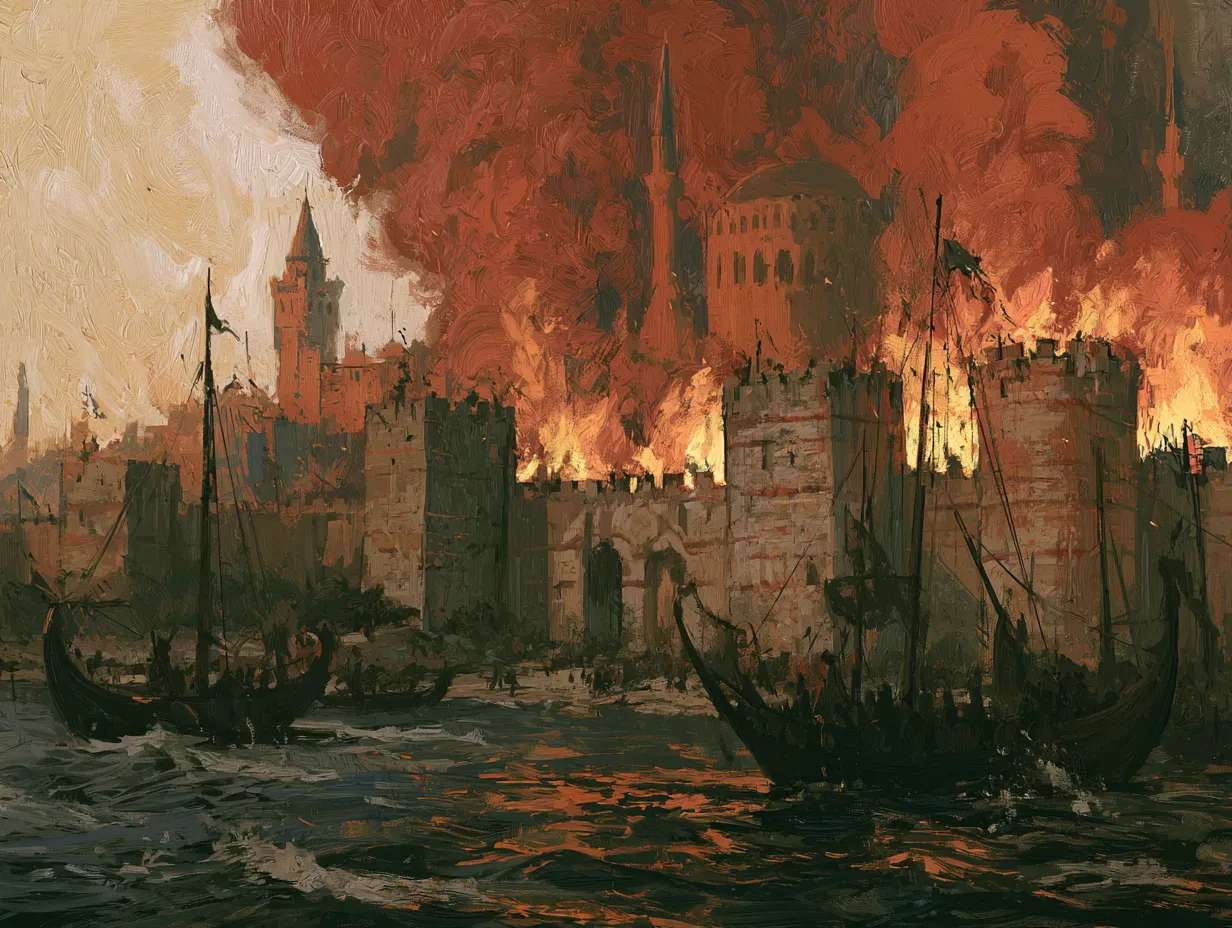
In the summer of 626 — exactly 1,400 years ago — the city of Constantinople faced one of the gravest threats in its thousand-year history. Two great powers, the nomadic Avars from the north and the Sassanid Persians from the east, closed in on the Byzantine capital at the same time, while the emperor himself was hundreds of miles away on campaign. For a few weeks it looked as though the eastern Roman Empire might be snuffed out in a single season.
It survived. The way it survived — and what it cost — helped shape the next eight centuries of European and Middle Eastern history. This is the story of the 626 siege: who attacked, why the city held, and why a battle most people have never heard of still mattered.
The Empire on the Brink
By 626 the Byzantine Empire — the surviving eastern half of the Roman world — had been at war with the Sassanid Persians for nearly two decades. It was going badly. The Persians under King Khosrow II had overrun Syria, Palestine, and Egypt, the empire's richest provinces. In 614 they had captured Jerusalem and carried off the relic believed to be the True Cross. Constantinople had lost its breadbasket and much of its tax base.
Emperor Heraclius, who had seized the throne in 610, made a daring strategic bet. Rather than defend the capital directly, he took the field army deep into Persian territory in the Caucasus, gambling that he could strike at the heart of the Sassanid Empire faster than the Persians could take his capital. It left Constantinople dangerously exposed — and the Persians, together with their new allies, moved to exploit exactly that.
A Coordinated Attack From Two Directions
The threat in 626 was unusual because it was coordinated. From the east came a Persian army under the general Shahrbaraz, which marched to Chalcedon on the Asian shore of the Bosphorus, directly across the water from the city.
From the north came the Avars, a confederation of Eurasian nomads who had built a powerful khaganate in the Carpathian Basin. The Avar Khagan brought a huge and varied host — Avars, Slavs, Bulgars, and Gepids — and laid siege to the land walls of Constantinople with siege towers and catapults. Estimates of the combined besieging force run to the tens of thousands, far outnumbering the defenders.
The plan was simple and deadly: the Avars would batter the land walls from Europe while the Persians supplied a second front from Asia. If the two armies could link up across the Bosphorus, the city's defenders would be overwhelmed.
Why the City Held
Two things saved Constantinople, and neither was the emperor.
The first was the defences themselves. The Theodosian Walls — a triple line of fortifications built in the 5th century — were the most formidable in the medieval world. For a thousand years they made Constantinople almost impossible to storm. The Avars had the numbers but not the means to break through stone that had been designed to defeat exactly this kind of assault.
The second was sea power. The whole Avar–Persian plan depended on ferrying the Persian army across the Bosphorus to join the assault. But the Byzantine navy controlled the water. When the Avars sent their Slavic allies across in dugout canoes to make the link-up, the Byzantine fleet intercepted and destroyed them. The two armies never combined. Cut off from his Persian partners and unable to crack the walls, the Avar Khagan abandoned the siege and withdrew.
The defence was organised not by Heraclius — who was still campaigning in the east — but by the Patriarch Sergius and the patrician (a senior official) Bonus, who held the city together through morale and discipline as much as military skill.
The Religious Aftershock
For the people inside the walls, deliverance felt like a miracle. The defenders had paraded an icon of the Virgin Mary along the walls, and when the siege broke, the survival of the city was widely credited to her protection.
That belief left a lasting mark on Orthodox Christianity. The famous Akathist Hymn, still sung in the Eastern Orthodox Church today, is traditionally associated with the thanksgiving for the city's salvation in 626. A military event became a religious memory — one reason the siege was never quite forgotten in the Orthodox world even as it faded elsewhere.
Why 626 Mattered
The failure of the 626 siege was a turning point. With his capital intact, Heraclius pressed his eastern campaign to its conclusion. In 627 he won a decisive victory at the Battle of Nineveh, and within months the Sassanid Empire collapsed into civil war. Khosrow II was overthrown and killed, the conquered provinces were returned, and the True Cross was recovered. Heraclius had won the longest and one of the most dangerous wars in Roman history.
The victory was also, tragically, hollow. Both the Byzantine and Sassanid empires had exhausted themselves in nearly thirty years of warfare. Within a decade, a new power emerged from Arabia: the armies of the early Islamic Caliphate swept through the very provinces — Syria, Palestine, Egypt — that Heraclius had just spent his empire's strength reconquering. The Sassanid Empire was destroyed entirely; Byzantium was permanently reduced.
So 626 sits at one of history's great hinge points. Had the city fallen, there would have been no Byzantine Empire to anchor Orthodox Christianity and Greek learning through the early Middle Ages — and the map of the eastern Mediterranean might look very different today. The same walls that held in 626 would go on protecting the city for another 800 years, until they were finally breached by Ottoman cannon in 1453, when the last emperor, Constantine XI Palaiologos, died defending them.
The siege of 626 is a reminder that history often turns not on famous battles but on the ones that almost happened — the catastrophes narrowly avoided. If you enjoy this kind of story, you might also like our pieces on why the Roman Empire fell and what the Janissaries were, or the wider question of how to learn history effectively.

Founder of Chunks Microlearning. Software engineer with 15 years of experience.
 Download on iOS
 Download on Android