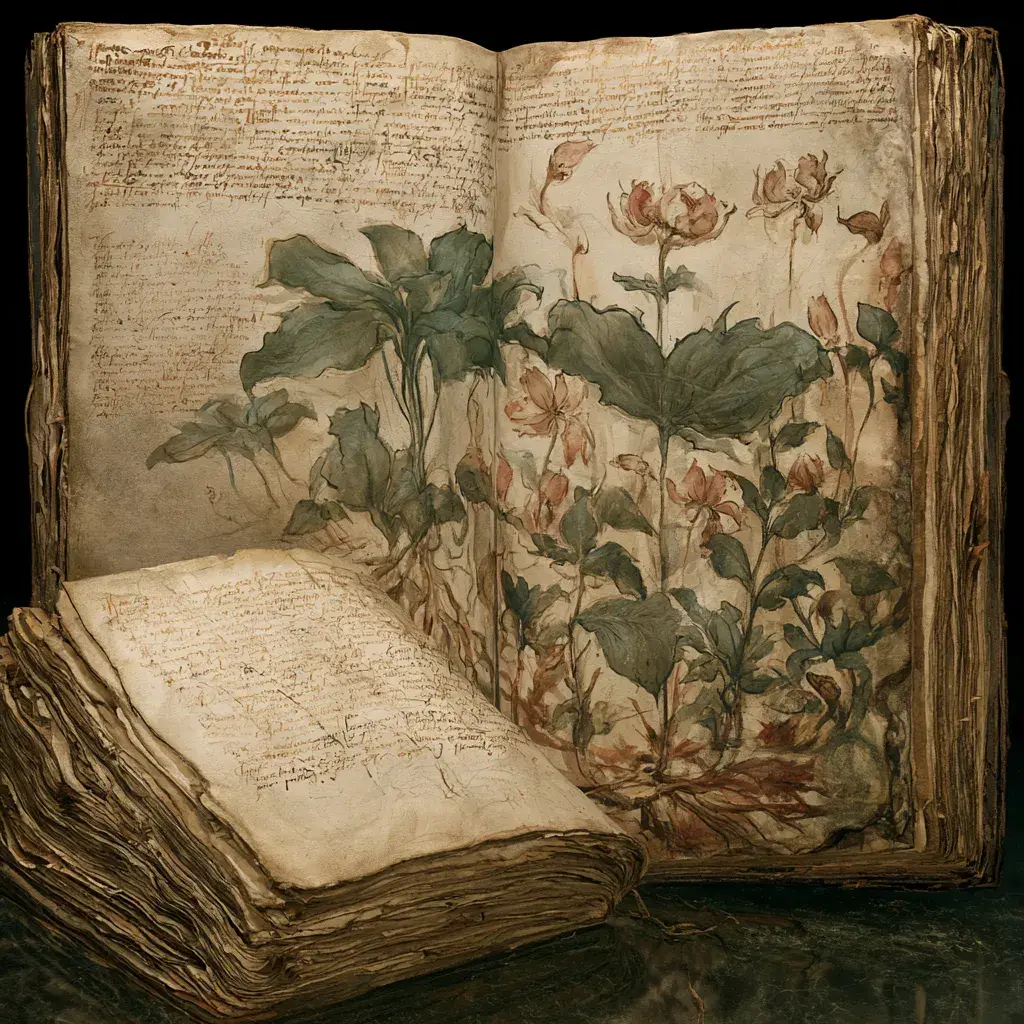
In 1912, a Polish-American book dealer named Wilfrid Voynich was in Italy when he purchased a strange manuscript from Jesuit priests. The book was a codex of about 240 vellum pages, but its contents were baffling. Instead of a known language, it was filled with a beautiful, flowing script that no one could read. Alongside the text were hundreds of bizarre drawings. There were detailed illustrations of plants that don't seem to exist on Earth and drawings of naked women bathing in pools of green liquid, connected by intricate pipes. Voynich knew he had found something unique, but he could not have imagined that over a century later, the book he bought would remain one of history's greatest unsolved puzzles. What was this strange book, and what secrets did it hold?
The Voynich Manuscript: History's Most Baffling Book
The Voynich Manuscript, a 15th-century book written in an unknown script and illustrated with unidentified plants, which no one has ever read.
Summary
The Voynich manuscript is a roughly 240-page codex written in an unknown script that has never been deciphered, illustrated with unidentifiable plants, astronomical diagrams and bathing figures. Its vellum has been carbon-dated to the early 15th century (1404–1438). It is named after Wilfrid Voynich, the book dealer who bought it in 1912, and is held at Yale University's Beinecke Rare Book & Manuscript Library as MS 408. Professional and amateur codebreakers — including the leading cryptanalysts of both world wars — have failed to crack it.
Key Facts
- Vellum carbon-dated to 1404–1438; the text was most likely written in the early 15th century
- Written in an unknown script, usually called "Voynichese", with no confirmed decipherment
- Named after book dealer Wilfrid Voynich, who purchased it in 1912
- Held at Yale University's Beinecke Rare Book & Manuscript Library, catalogued as MS 408
- Sections are conventionally labelled herbal, astronomical, balneological, cosmological and pharmaceutical after their illustrations
- William Friedman, the leading US cryptanalyst of the 20th century, studied it for decades without success
The Mysterious Book
People in this story

Part of
Frequently Asked Questions
What is the Voynich Manuscript?
It is a roughly 240-page codex from the early 15th century. It is filled with an undeciphered script and strange illustrations of unknown plants, astrological charts, and naked women in bizarre plumbing systems.
Has the Voynich Manuscript ever been decoded?
No. Despite numerous attempts by professional cryptographers, including top US codebreakers during WWII, and modern AI, no one has produced a verifiable translation. The manuscript's language and meaning remain a complete mystery.
Is the Voynich Manuscript a fake?
Radiocarbon dating in 2009 confirmed the manuscript's vellum pages were made between 1404 and 1438. Analysis of the ink also shows it is consistent with medieval materials, proving it is a genuine historical artifact, not a modern forgery.
Learn more
To continue the story, download the Chunks Microlearning app
Or get it straight away:
 Download on iOS
 Download on Android