
In 1799, a group of French soldiers stationed in Egypt made an unexpected discovery while fortifying a crumbling fort near the town of Rosetta. Unearthed from the dusty ground was a heavy, broken slab, covered in mysterious scripts. The soldiers had no idea that this stone would become one of the most important archaeological finds in history. The Rosetta Stone, as it came to be called, was inscribed with three distinct scripts: Greek, Demotic, and Egyptian hieroglyphs. At the time, no one could read hieroglyphs—not even the most learned scholars. But the Greek text offered a tantalizing clue: it stated that the inscription was the same in all three scripts. Suddenly, the possibility of unlocking the secrets of ancient Egypt seemed within reach. As news of the find spread, scholars and adventurers across Europe turned their attention to this enigmatic stone, eager to be the first to decipher its secrets. Little did anyone know, this accidental discovery would spark an international race that would ignite rivalries, inspire obsession, and ultimately change our understanding of history.
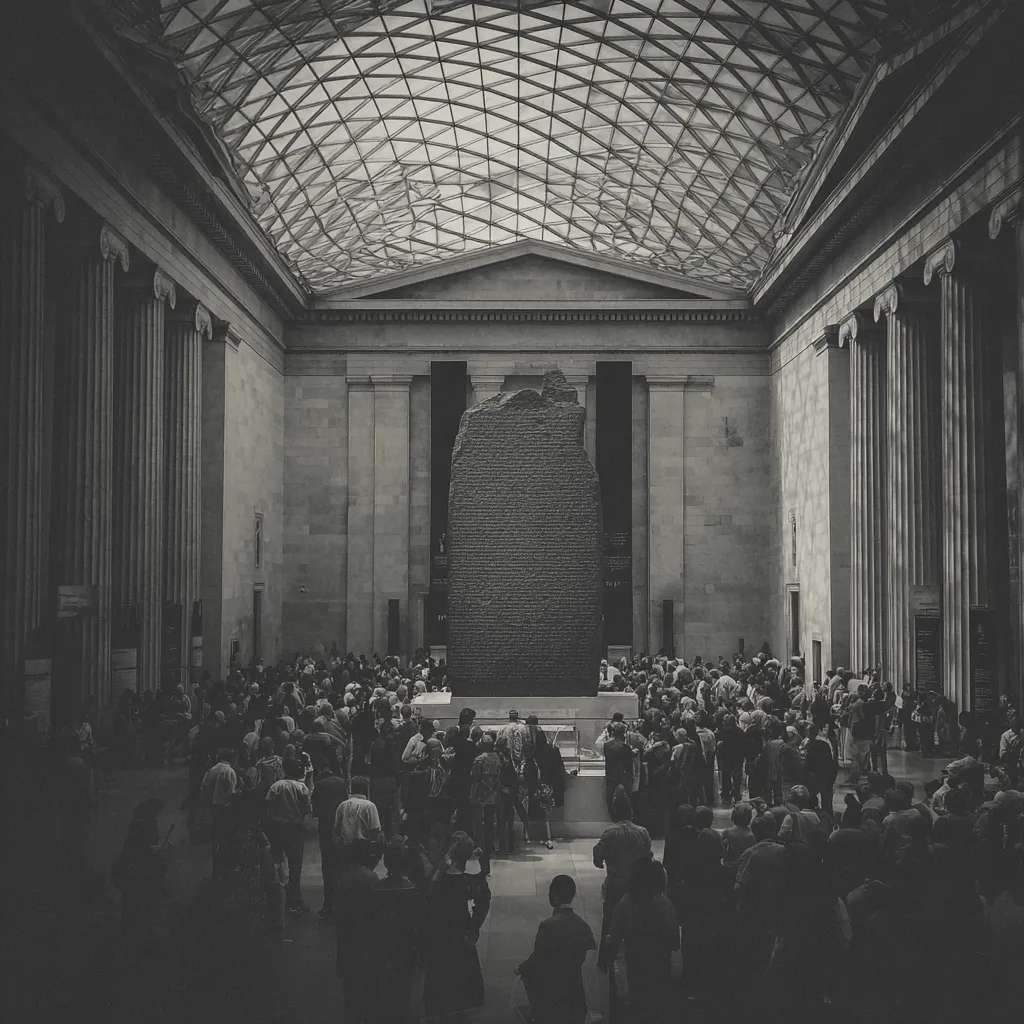
The Rosetta Stone
A forgotten slab, secret languages, and the puzzle that unlocked a lost civilization.
A Discovery in the Dust
Frequently Asked Questions
What exactly is the Rosetta Stone and why is it so important to archaeology?
The Rosetta Stone is an ancient Egyptian granite slab dating to 196 BCE that contains the same decree written in three different scripts: hieroglyphics, Demotic, and ancient Greek. Its importance lies in providing the key to deciphering Egyptian hieroglyphics, which had been a mystery for over a thousand years. The stone allowed scholars to finally unlock the language and culture of ancient Egypt.
Who was Jean-François Champollion and how did he crack the hieroglyphic code?
Jean-François Champollion was a French linguist and Egyptologist who successfully deciphered Egyptian hieroglyphics in 1822. He used the Rosetta Stone's trilingual text to identify that hieroglyphs could represent both sounds and ideas, not just pictures. By comparing the known Greek text with the hieroglyphic version and focusing on royal names like Ptolemy and Cleopatra, he breakthrough the ancient writing system.
How did the Rosetta Stone end up in the British Museum instead of staying in Egypt?
The Rosetta Stone was discovered by French soldiers in 1799 during Napoleon's Egyptian campaign near the town of Rosetta. When the French were defeated by the British in Egypt in 1801, the stone became a spoil of war under the Treaty of Alexandria. The British transported it to London, where it has remained in the British Museum since 1802, despite ongoing calls from Egypt for its return.
Learn more
To continue the story, download the Chunks Microlearning app
 Download on iOS
 Download on Android