
Far out in the vast blue waters of the Pacific Ocean, more than 2,000 miles from any major land, lies a remote speck of land known as Easter Island. For centuries, this isolated island has baffled explorers and archaeologists alike. What drew people to such a distant place? And why did they undertake the incredible task of carving hundreds of giant stone heads, called moai, and scattering them across the windswept landscape? The answers have remained elusive. The Rapa Nui, the indigenous people of Easter Island, arrived here more than a thousand years ago. With limited resources, they built a complex society and left behind one of the world’s most mysterious archaeological legacies. As you imagine the island’s rolling green hills and the silent, watchful faces of the moai, prepare to journey back in time. In this story, we will explore how the Rapa Nui crafted their stone giants, how they moved them across the island, and what secrets these statues still hold. Welcome to the mystery of Easter Island, where questions outnumber answers and every stone has a story.
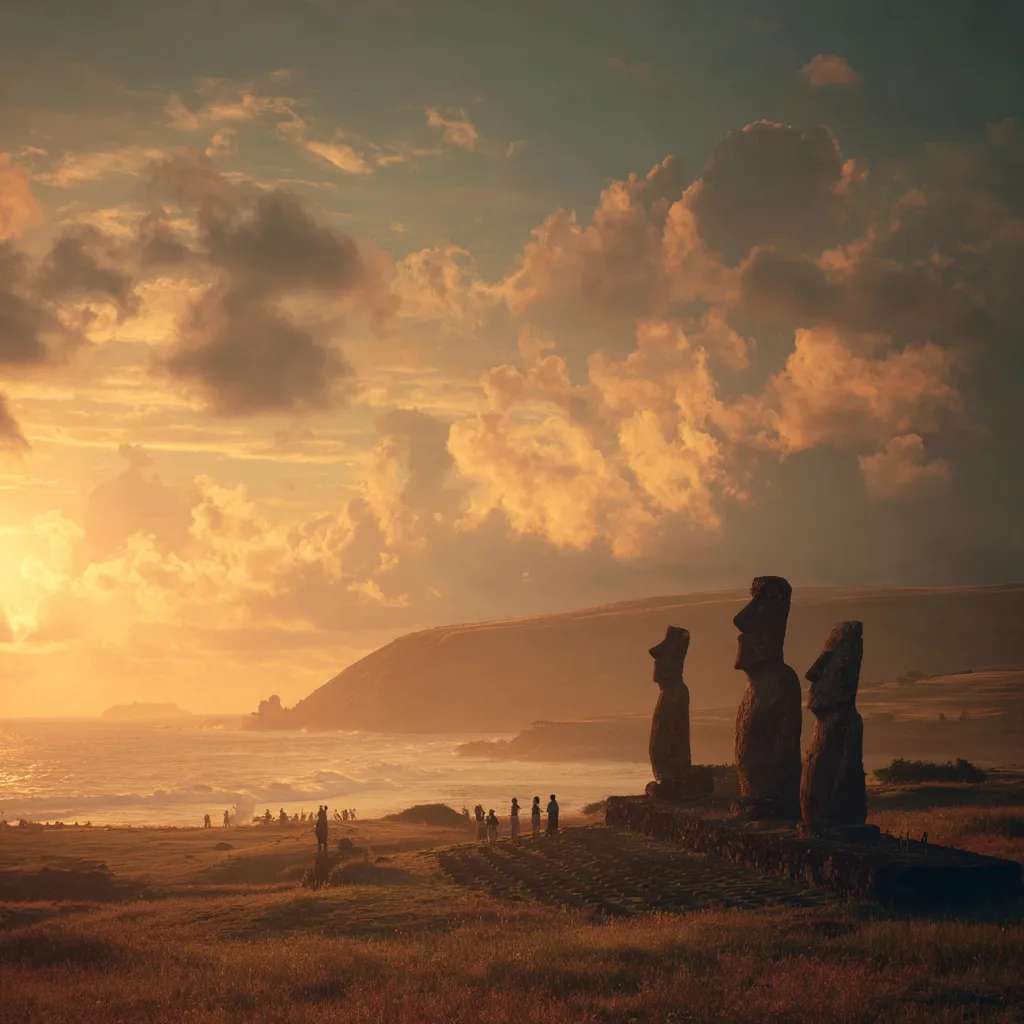
The Mystery of Easter Island
Uncover how the Rapa Nui carved and moved their giant stone heads.
A Remote Island Shrouded in Mystery
Frequently Asked Questions
How did the Rapa Nui people move the massive moai statues across Easter Island?
The Rapa Nui likely used a combination of ropes, wooden rollers, and coordinated rocking motions to transport the moai. Recent experiments suggest teams of people could have "walked" the statues upright using ropes tied around the heads and bases. Some moai may have also been moved on wooden sledges or rolled on logs across the island's terrain.
What tools did the Rapa Nui use to carve the giant moai statues?
The Rapa Nui carved the moai using simple stone tools called toki, which were hand axes made from hard basalt rock. These tools were used to chip away at the volcanic tuff rock at Rano Raraku quarry where most moai were carved. The carving process required immense skill and patience, with each statue taking months or years to complete.
Why did the Rapa Nui civilization on Easter Island collapse?
The Rapa Nui civilization likely collapsed due to a combination of environmental degradation, overpopulation, and resource depletion. Deforestation eliminated the island's palm trees needed for canoes and statue transport, while soil erosion reduced agricultural productivity. These environmental pressures may have led to social conflict and population decline before European contact in the 18th century.
Learn more
To continue the story, download the Chunks Microlearning app
 Download on iOS
 Download on Android