
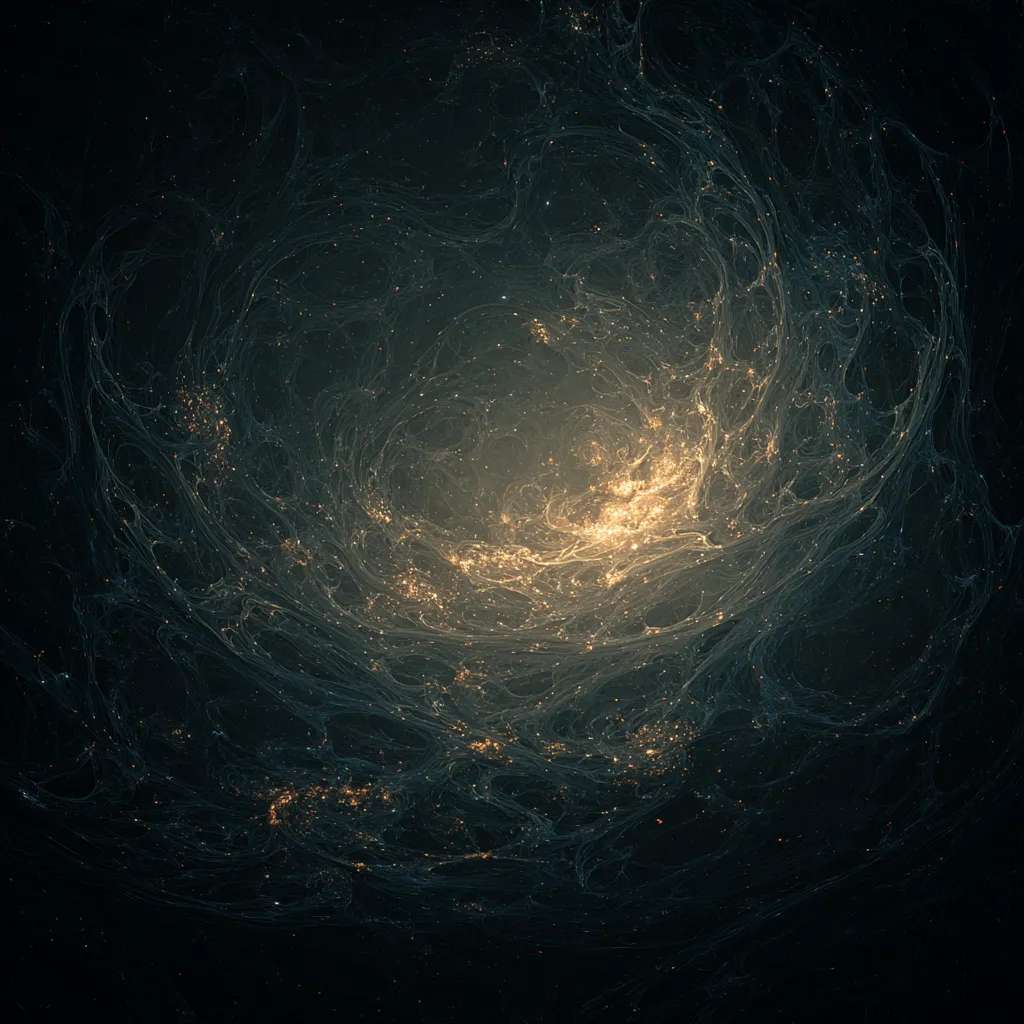
Imagine the universe as it is now, with all its stars, planets, and galaxies. Now, try to picture it compressed into a tiny, unimaginably dense point. This is where our story starts. Scientists call this the singularity, a state in which all the energy and matter in the universe was packed into a space smaller than a pinhead. Around 13.8 billion years ago, something extraordinary happened. In a fraction of a second, this singularity began to expand rapidly. This event is what we call the Big Bang. It wasn't an explosion in space, but rather an expansion of space itself. Time, space, and matter all came into existence at that moment. The universe began to grow, cooling and spreading out. The Big Bang Theory is our best explanation for how the universe started, and it is supported by a wealth of evidence. But what caused this event, and what happened next? Stay tuned as we explore the mysteries that followed the birth of everything.
The Big Bang Theory
A captivating journey through the science, mystery, and wonder of the Big Bang Theory.
A Universe Begins
Frequently Asked Questions
What exactly is the Big Bang Theory and how does it explain the origin of the universe?
The Big Bang Theory is the prevailing scientific model explaining how the universe expanded from an extremely hot, dense initial state approximately 13.8 billion years ago. The theory describes how space itself expanded rapidly, cooling as it grew, eventually allowing matter to form and clump together into the structures we see today. This model is supported by multiple lines of evidence including cosmic microwave background radiation and the observed expansion of the universe.
What happened during the first moments after the Big Bang when the universe was described as 'cosmic soup'?
During the first fraction of a second after the Big Bang, the universe existed as an extremely hot, dense plasma of fundamental particles including quarks, electrons, and photons. This 'cosmic soup' was so hot and dense that atoms could not form because electrons were constantly being knocked away from atomic nuclei. The universe gradually cooled as it expanded, allowing these particles to eventually combine into more stable structures.
When and how did the first atoms form in the early universe?
The first atoms formed approximately 380,000 years after the Big Bang during an event called recombination. As the universe continued to expand and cool, temperatures dropped enough for electrons to finally bind with atomic nuclei, primarily forming hydrogen and helium atoms. This moment marked the end of the cosmic dark age because light could finally travel freely through space, creating what we now detect as the cosmic microwave background radiation.
Learn more
To continue the story, download the Chunks Microlearning app
 Download on iOS
 Download on Android