
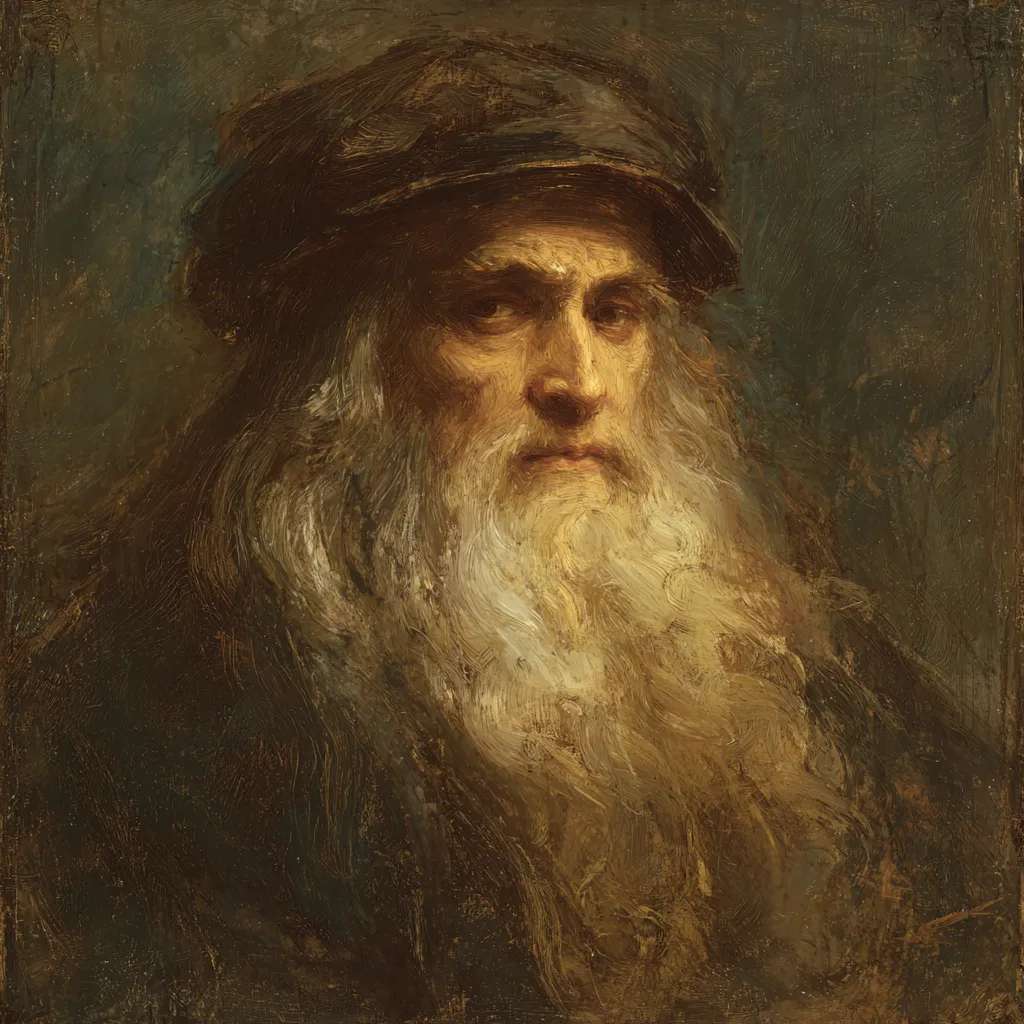
Who was Leonardo da Vinci?
Leonardo da Vinci (15 April 1452 – 2 May 1519) was an Italian polymath of the High Renaissance, active as a painter, engineer, scientist, sculptor, and architect. Born near Vinci in Tuscany, he created the world's most famous painting, the Mona Lisa, and the most reproduced religious painting of all time, The Last Supper, while filling thousands of notebook pages with studies of anatomy, flight, and invention.
Leonardo da Vinci (1452–1519) was an Italian Renaissance polymath whose genius spanned art, science, engineering, anatomy, and invention. Best known for masterpieces like The Mona Lisa and The Last Supper, Leonardo believed that careful observation of nature was the key to all knowledge. He filled thousands of notebook pages with studies of the human body, flight, machines, and natural phenomena—many ideas far ahead of his time. Leonardo became the enduring symbol of the “Renaissance man,” driven by relentless curiosity and the belief that art and science are inseparable.
Don't stop at the facts — continue Leonardo da Vinci's story in free narrated chapters on Chunks.
 Download on iOS
 Download on Android
Quick facts
- Born
- 15 April 1452
- Birthplace
- Anchiano
- Died
- 2 May 1519
- Place of death
- Clos Lucé
- Nationality
- Republic of Florence
- Occupation
- Painter, engineer, astronomer
Leonardo da Vinci: key facts
- Leonardo da Vinci was born on 15 April 1452 in or near the Tuscan hill town of Vinci, approximately 35 kilometres from Florence, and died on 2 May 1519 at the manor house Clos Lucé in France.
- Leonardo trained from around age 14 in the Florence workshop of Andrea del Verrocchio, where he was exposed to drafting, chemistry, metallurgy, and artistic skills including drawing, painting, and sculpting.
- The Mona Lisa is widely regarded as the world's most famous individual painting, and The Last Supper is the most reproduced religious painting of all time.
- In 2017, Salvator Mundi, attributed in whole or part to Leonardo, sold at public auction for US$450.3 million, setting a record for the most expensive painting ever sold at auction.
- Leonardo filled approximately 13,000 pages of notebooks with drawings and notes on subjects including anatomy, astronomy, botany, cartography, and palaeontology, most written in mirror-image cursive.
- Leonardo first recorded the laws of sliding friction in 1493, but his findings were never published; the same laws were not independently rediscovered until 1699 by Guillaume Amontons.
- Upon the invitation of King Francis I of France, Leonardo spent his final years at Clos Lucé near the Château d'Amboise, supported by a pension of 10,000 scudi, and died there on 2 May 1519.
An Illegitimate Birth Near Florence and a Florentine Education
Leonardo di ser Piero da Vinci was born on 15 April 1452 in or near the Tuscan hill town of Vinci, roughly 35 kilometres from Florence. He was born out of wedlock to Piero da Vinci, a successful Florentine notary, and Caterina di Meo Lippi, a woman of lower social standing. Both parents married other people the following year, and Leonardo grew up largely in the household of his paternal grandfather, Antonio da Vinci. He had very little contact with the 16 half-siblings who eventually came from his father's subsequent marriages.
Despite his father's long professional lineage, Leonardo received only a basic informal education in reading, writing, and mathematics. Around the age of 14, he entered the workshop of Andrea del Verrocchio, then the leading painter and sculptor in Florence. There he trained alongside future masters including Botticelli, Ghirlandaio, and Perugino. The workshop exposed Leonardo not just to painting and sculpting but to drafting, metallurgy, chemistry, mechanics, and plaster casting. By the age of 20 he had qualified as a master in the Guild of Saint Luke, though he continued living and working with Verrocchio for years afterward.
Milan, The Last Supper, and the Court of Ludovico Sforza
In 1482, Lorenzo de' Medici sent Leonardo to Milan as an ambassador to Ludovico Sforza. Leonardo had written Sforza a letter emphasising his abilities in engineering and weapon design, mentioning his painting almost as an afterthought. He remained in Milan until 1499, working across an extraordinary range of projects. These included designing pageants and floats, producing a model for a cupola competition for Milan Cathedral, and planning a colossal bronze equestrian statue honouring Ludovico's predecessor Francesco Sforza. The metal set aside for that statue was ultimately handed over to be cast into a cannon to defend against the advancing forces of Charles VIII of France.
The most celebrated work of this period was The Last Supper, painted for the refectory of Santa Maria delle Grazie. Rather than using the durable technique of true fresco, Leonardo applied tempera over a gesso ground, a choice that caused the painting to deteriorate within decades. The composition depicted the moment Christ announced that one of his disciples would betray him, capturing each figure's individual reaction. A contemporary writer observed Leonardo sometimes painting without pause from dawn to dusk, then not picking up a brush again for several days. The painting was immediately recognised as a masterpiece of characterisation and design, and it remains the most reproduced religious painting ever made.
The Mona Lisa, Anatomical Studies, and Restless Movement Between Cities
After French forces ousted Ludovico Sforza in 1499, Leonardo moved to Venice before returning to Florence. By October 1503 he had begun a portrait of Lisa del Giocondo, the work now known as the Mona Lisa. He continued refining it for years, and it remained with him until his death. The painting became renowned for the elusive quality of the sitter's expression, produced through Leonardo's technique of softly blurring the corners of the mouth and eyes. This approach, which came to be called sfumato, gave the work a shadowy, atmospheric depth unlike anything in earlier portraiture.
Across these same years, Leonardo pursued anatomy with the same intensity he brought to painting. He obtained permission to dissect human corpses at hospitals in Florence, Milan, and Rome, producing more than 240 detailed drawings of the skeleton, muscles, organs, and vascular system. He made one of the first scientific illustrations of a foetus inside the womb and was the first to identify atherosclerosis and liver cirrhosis. Working briefly with the anatomist Marcantonio della Torre at the University of Pavia between 1510 and 1511, Leonardo assembled material toward a comprehensive treatise. None of it was published in his lifetime, meaning these advances had no direct influence on medical science until much later.
Notebooks Filled With Inventions, Friction Laws, and Studies of Flight
Leonardo's notebooks, amounting to roughly 13,000 pages of notes and drawings, cover subjects from geology and optics to hydraulics, architecture, and the flight of birds. He designed flying machines including a flapping ornithopter and a device with a helical rotor. He conceptualised an armoured fighting vehicle, concentrated solar power, and a double-hulled boat. Most of these designs were never built, partly because the metallurgy and engineering of the Renaissance were not yet capable of realising them. A few smaller inventions did enter practical use without fanfare, among them an automated bobbin winder and a machine for testing the tensile strength of wire.
In 1493 Leonardo recorded in his notebooks what are now recognised as the foundational laws of sliding friction, arrived at partly through his attempts to understand why perpetual motion was impossible. These findings were never published, and the same laws were independently rediscovered by Guillaume Amontons in 1699. This pattern repeated itself across many fields: Leonardo made genuine discoveries in anatomy, hydrodynamics, optics, and geology, yet because he did not publish, his work had little measurable effect on the scientists who followed him.
Final Years in France Under the Patronage of Francis I
In 1516 Leonardo accepted an invitation from King Francis I of France and relocated to the manor house of Clos Lucé, near the royal residence at the Château d'Amboise. He was given a generous pension and was frequently visited by the king himself. Leonardo drew plans for an enormous castle town Francis intended to build at Romorantin and constructed a mechanical lion that walked toward the king during a pageant and opened its chest to reveal a cluster of lilies. His companion throughout this period was Francesco Melzi, a Lombard aristocrat who had become his favourite pupil and who would eventually inherit Leonardo's paintings, tools, and library.
By around 1517, Leonardo's right hand was recorded as paralytic, which may explain why several works including the Mona Lisa were never brought to a state he considered finished. He continued working in some capacity until illness confined him to bed in his final months. Leonardo died at Clos Lucé on 2 May 1519 at the age of 67. He was buried at the collegiate church of Saint Florentin at the Château d'Amboise, though the church was demolished in 1802 and the precise location of his remains has been uncertain ever since. Some years after his death, Francis I reportedly told the sculptor Benvenuto Cellini that no other man born into the world had known as much as Leonardo.
Leonardo da Vinci: timeline
- 1452Born out of wedlock to a Florentine notary and a lower-class woman in or near the hill town of Vinci, Tuscany.
- c. 1466Moved to Florence and entered the workshop of leading painter and sculptor Andrea del Verrocchio as a studio boy, beginning an apprenticeship that lasted seven years.
- 1472Qualified as a master in the Guild of Saint Luke in Florence, though he continued to collaborate and live with Verrocchio.
- 1482Left Florence for Milan, sent as an ambassador by Lorenzo de' Medici to Ludovico Sforza, and began an extended period in Sforza's service as painter and engineer.
- 1490sPainted The Last Supper for the refectory of the monastery of Santa Maria delle Grazie in Milan, a work that became the most reproduced religious painting of all time.
- 1499Fled Milan after Ludovico Sforza was overthrown by France, travelling to Venice before returning to Florence.
- 1503Began work on a portrait of Lisa del Giocondo, the painting now known as the Mona Lisa, which he continued refining for years.
- 1513Travelled to Rome, where he lived in the Belvedere Courtyard of the Apostolic Palace and worked under the patronage of Giuliano de' Medici.
- 1516Accepted an invitation from King Francis I of France and relocated to the manor house Clos Lucé near the royal Château d'Amboise, entering the king's service.
- 1519Died at Clos Lucé at the age of 67, with his friend and pupil Francesco Melzi named as principal heir to his paintings, tools, library, and personal effects.
Listen: stories featuring Leonardo da Vinci
Narrated chapters from the Chunks Microlearning app. Read a preview here, or listen to the full story in the app.
Continue Leonardo da Vinci's story
You've read the summary — hear the full story as narrated 5-minute chapters on Chunks, alongside 200+ figures and events from history, philosophy and science. Free to start on iOS and Android.